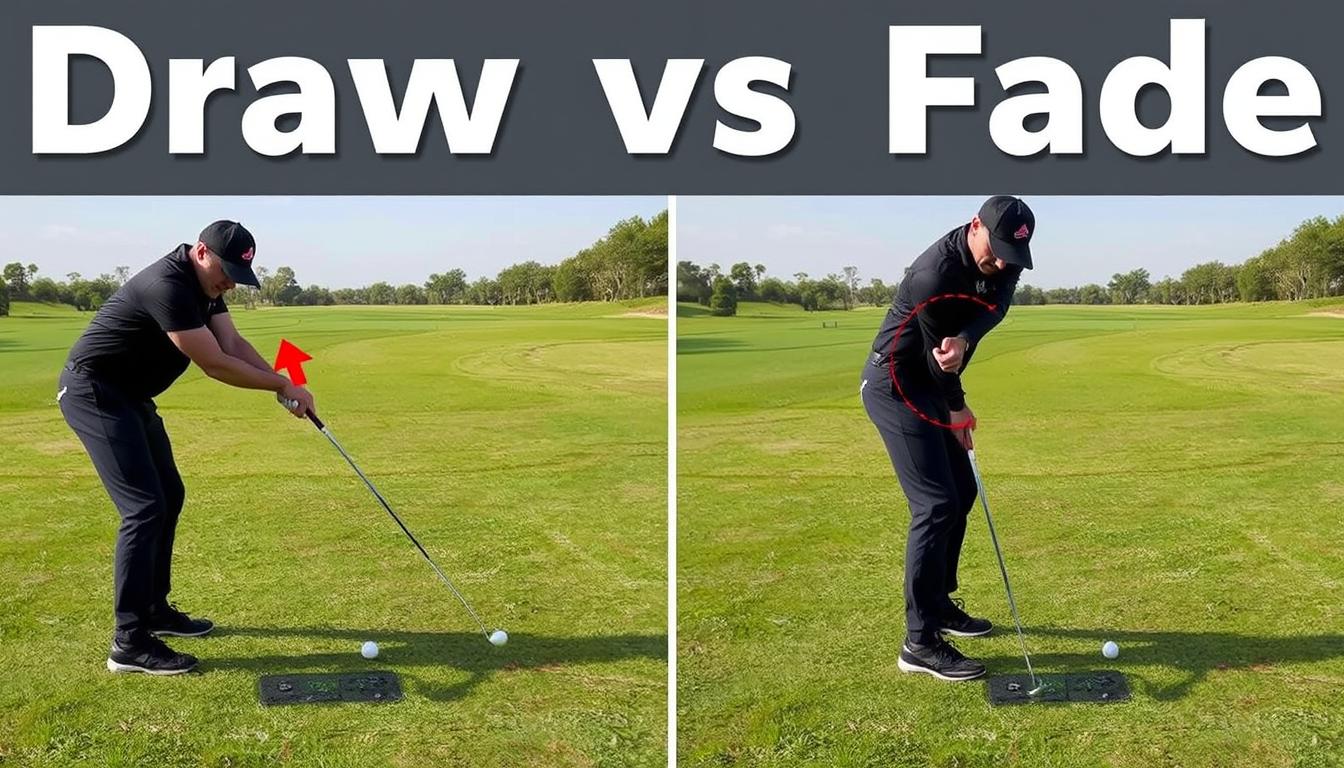
The golf industry in the United States generates over $26 billion in revenue annually. This figure underscores the sport’s immense popularity and its significant economic impact. Delving into golf shot shapes, particularly draws and fades, can significantly improve your game.
Golf is not solely about hitting straight shots. The skill to shape your ball flight with controlled curves is crucial. Mastering draw and fade techniques enables you to overcome course obstacles and tailor your shot trajectory. This gives you a competitive edge on the green.
For both beginners and seasoned golfers, understanding draw and fade shots is vital for game improvement. These techniques involve altering the ball’s spin to produce specific flight paths. This adaptation is key to navigating various course conditions and challenges.
Key Takeaways
- Draws curve left for right-handed golfers, while fades curve right
- Understanding draw and fade techniques is essential for improving your golf game
- These controlled shots help navigate course obstacles and optimize ball flight
- Mastering draw and fade shots can give you a competitive advantage
- Both techniques involve manipulating the ball’s spin for specific flight paths
- Draw and fade shots help adapt to various course conditions and challenges
Table of Contents
- 1 Understanding Golf Shot Shapes
- 2 What is a Draw in Golf?
- 3 What is a Fade in Golf?
- 4 Mechanics of Hitting a Draw
- 5 Setup for a Draw
- 6 Swing Technique for a Draw
- 7 Best Drills for Hitting Consistent Draw Shots
- 8 Setup for a Fade
- 9 Swing Technique for a Fade
- 10 Best Drills for Hitting Consistent Fade Shots
- 11 Benefits of a Draw
- 12 Benefits of a Fade
- 13 Personal Preferences and Natural Tendencies for the Right Shot Shape
- 14 Strategic Considerations for the Right Shot Shape
- 15 Common Mistakes and How to Avoid Them
- 16 Misalignment and Setup Errors
- 17 Inconsistent Swing Path
Understanding Golf Shot Shapes
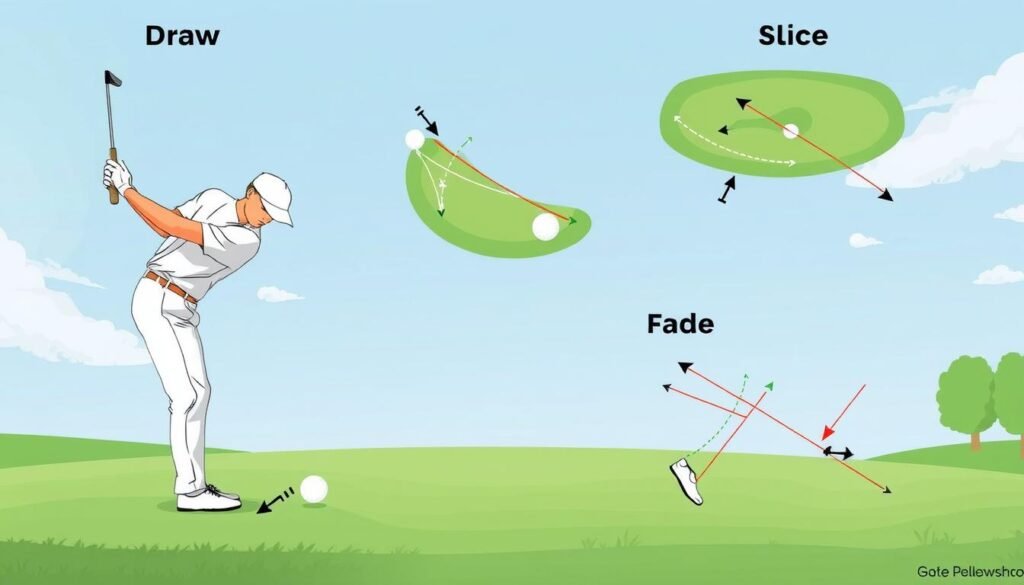
Golf shot shapes are crucial for any golfer aiming to elevate their skills. The mastery of ball spin and shot trajectory significantly impacts your performance. Let’s explore the intricacies of golf ball flight and controlled curves.
Shot shaping entails curving the ball’s flight path intentionally. This is done by applying spin at impact. Unlike slices or hooks, these shots begin straight before curving. Developing these skills helps you overcome obstacles, counteract wind, and boost your overall performance.
There are two primary types of shot shapes: draws and fades. For right-handed golfers, a draw curves from right to left, whereas a fade curves from left to right. Each type is beneficial in different situations on the course.
Here are some key statistics about shot shapes:
- Draws tend to roll more, with up to a 15-yard curve for a driver and around 8 yards for an 8-iron.
- A fade can curve between 1 to 15 yards for a driver, depending on the club used.
- Professionals often prefer a fade with the driver for better control, opting for consistency over extra distance.
- Golfers shooting in the 70s or better often intentionally curve most shots played from beyond 130 yards.
What is a Draw in Golf?

A draw in golf is a shot that curves from right to left for right-handed players. This shot shape results from imparting specific spin on the ball, leading to a right-to-left ball flight. Let’s explore the characteristics and applications of a draw shot.
Definition of a Draw Shot
A draw is a golf shot where the ball starts right of the target and curves back towards it. This curve is achieved by creating left sidespin on the ball at impact. The draw spin makes the ball follow a curved path, bending 1 to 15 yards with a driver and about 8 yards with shorter clubs like an 8-iron.
Characteristics of a Draw
The key features of a draw include:
- Right-to-left ball flight for right-handed golfers
- Lower launch angle compared to a fade
- Controlled curve that brings the ball back to the target
- Slightly delofted clubface at impact
Common Situations to Use a Draw
A draw is beneficial in several situations:
- Dogleg left holes: Shape the ball around the bend
- Approaching left-side pins: Curve the ball towards the flag
- Escaping trouble: Navigate around obstacles
- Cutting through headwinds: Achieve a lower ball flight
| Shot Type | Curve Direction | Typical Curve (Driver) | Launch Angle |
|---|---|---|---|
| Draw | Right to Left | 1-15 yards | Lower |
| Fade | Left to Right | 1-15 yards | Higher |
What is a Fade in Golf?
A fade in golf is a shot that curves to the right for right-handed players. It’s a preferred shot among pros, like Dustin Johnson’s powerful shot, and can be a key addition to your golf skills. Johnson uses precise positioning, body rotation, and club control for this curve. Let’s explore this strategic shot further.
Definition of a Fade Shot
A fade is a shot where the ball starts left of the target and curves right. This happens when the clubface is slightly open at impact. This setup gives the ball fade spin, leading to a controlled curve.
Characteristics of a Fade
For right-handed golfers, a fade means the ball flies left to right. The main traits of a fade include:
- Initial direction left of the target
- Gentle curve to the right
- Higher ball flight compared to a draw
- Softer landing on the green
Common Situations to Use a Fade
A fade is useful in many situations:
- Dogleg right holes: The ball curves to follow the hole’s shape
- Right-side pin placements: Ensures a softer landing
- Avoiding left-side hazards: The ball moves right to clear trouble
- Windy conditions: Helps control the ball’s flight in crosswinds
Mechanics of Hitting a Draw
To master the draw in golf, you must understand specific swing mechanics. The essence is to create an inside-out swing path with a closed clubface. This combination ensures the right-to-left spin that defines a draw shot.
- Align your body slightly right of the target
- Swing along your body line
- Keep the clubface pointed at the target
- Create an inside-out swing path
- Close the clubface relative to the swing path at impact
The inside-out swing path is essential for generating draw spin. This path, when combined with a closed clubface, can result in a shot curving from 1 to 15 yards with a driver. For shorter clubs like an 8-iron, the curve is about 8 yards.
Setup for a Draw
Mastering the draw shot in golf requires a precise setup, focusing on stance, stance alignment, and clubface alignment. This setup is crucial for shaping your shots effectively and enhancing your game. Let’s delve into the essential elements of a proper draw setup.
Stance and Alignment
Your stance is pivotal for a successful draw shot. Here are the steps to follow:
- Position your feet slightly right of the target line
- Align your shoulders parallel to your feet
- Keep your hips square to your stance line
- Point your clubface at the target
Ball Position and Clubface Angle
Correct ball positioning and clubface alignment are vital for a draw:
- Place the ball slightly back in your stance
- Close the clubface slightly relative to your stance
- Aim for a 1-2 degree inside-out swing path
Grip Adjustments
Adjusting your grip can significantly improve your draw shot:
- Strengthen your left hand grip (for right-handed golfers)
- Rotate your left hand slightly to the right on the club
- Keep your right hand neutral or slightly strong
Swing Technique for a Draw
Mastering the draw swing path is essential for a consistent draw in golf. This shot shape offers a significant advantage, allowing you to overcome obstacles and shape your shots precisely. It’s a technique that can set you apart on the course.
Inside-out Swing Path
A successful draw requires an inside-out swing path. This means swinging the club from inside the target line to outside after impact. To master this:
- Set up with your feet and shoulders slightly closed to the target line
- Focus on rotating your body through the shot
- Feel like you’re swinging to right field (for right-handed golfers)
Clubface Control
Proper clubface control is vital for a consistent draw. Keep the clubface slightly closed relative to your swing path through impact. Here’s how:
- Strengthen your grip by rotating your hands slightly to the right on the club
- Maintain a steady wrist angle throughout the swing
- Release the club naturally through impact
Tips for Consistent Draw Shots
To enhance your draw swing technique:
- Practice maintaining your spine angle throughout the swing
- Avoid over-rotating your hands, which can lead to a hook
- Use alignment sticks to ensure proper setup and swing path
- Start with half swings to groove the correct motion before progressing to full swings
| Element | Draw Shot | Fade Shot |
|---|---|---|
| Swing Path | Inside-out | Outside-in |
| Clubface Angle | Slightly closed | Slightly open |
| Ball Flight | Right to left | Left to right |
| Grip | Strong | Weak |
Best Drills for Hitting Consistent Draw Shots
Mastering draw shots is essential for golf training. These drills can significantly enhance your game. Let’s delve into effective draw practice drills for consistency.
- Alignment Stick Drill
- Place a stick on the ground pointing right of your target
- Aim your clubface at the target
- Align your body parallel to the stick
- Practice hitting shots with this setup
- Gate Drill
- Set up two tees or alignment sticks creating a gate
- Position the gate slightly right of your target
- Start the ball through the right side of the gate
- Focus on drawing it back towards the target
- Feet-Together Drill
- Take your normal stance
- Bring your feet close together
- Hit shots with this narrow stance
- This promotes an inside-out swing path
- Half-Swing Drill
- Set up for a normal shot
- Make half swings focusing on path and face control
- Gradually increase swing length as you improve
- This drill helps refine your technique
Adding these draw practice drills to your golf training can lead to more consistent shot shaping. Remember, mastering the draw requires time and patience. Regular practice with these exercises will help you develop the skills needed for effective shot shaping on the course.
| Drill | Main Focus | Benefit |
|---|---|---|
| Alignment Stick | Proper setup | Improved aim and alignment |
| Gate | Ball start direction | Better control of initial ball flight |
| Feet-Together | Inside-out path | Enhanced swing path for draws |
| Half-Swing | Face control | Refined clubface manipulation |
Setup for a Fade
Mastering the fade setup is essential for golfers seeking to enhance their game’s versatility. A fade, curving gently from left to right for right-handed players, is a powerful tool. Let’s explore the key elements of a proper fade setup.
Stance and Alignment
Your stance is crucial for executing a fade. Begin by aligning your feet and body slightly left of the target. This open stance lays the groundwork for the outside-in swing path necessary for a fade.
Ball Position and Clubface Alignment
For an effective fade setup, place the ball slightly forward in your stance. Aim the clubface directly at your target while keeping your body aligned left. This slight difference between body alignment and clubface direction is crucial for the desired fade shape.
Grip Adjustments
Adjusting your grip can promote a more open clubface at impact, vital for a fade. Consider these adjustments:
- Weaken your left hand grip (for right-handed golfers)
- Rotate both hands slightly to the left on the club
- Ensure your grip pressure remains light and consistent
Swing Technique for a Fade
Mastering the fade swing path is essential for golfers aiming to enhance their game’s versatility. A well-executed fade shot offers greater control and precision, crucial on challenging courses. Let’s explore the key elements for a successful fade shot.
Outside-in Swing Path
The outside-in swing path is fundamental to the fade. This method involves swinging the club from outside the target line to inside after impact. To execute this effectively:
- Align your feet slightly left of the target
- Keep your shoulders parallel to the target line
- Swing the clubhead along an imaginary line outside your target line
- Follow through with the club moving inside the target line
Clubface Control Through Impact
Proper clubface control is vital for consistent fades. To maintain the correct clubface angle:
- Keep the clubface slightly open relative to the swing path
- Focus on a square impact position
- Rotate your body through the shot while maintaining spine angle
Tips for Consistent Fade Shots
To enhance your fade shots, consider these tips:
- Practice with alignment sticks to visualize the correct swing path
- Use a lower launch angle for more control
- Experiment with ball position, moving it slightly forward in your stance
- Focus on a smooth, controlled swing to avoid over-cutting the ball
Best Drills for Hitting Consistent Fade Shots
Mastering the fade shot is essential for enhancing your golf training. These drills focus on perfecting your fade, thereby boosting your overall game. Let’s explore some effective fade practice drills.
- Alignment Stick Drill:Place a stick on the ground pointing left of your target
- Aim your clubface at the target
- Align your body parallel to the stick
- Gate Drill:Set up two tees or alignment sticks creating a gate
- Start the ball through the left side of the gate
- Practice fading it back towards the target
- Towel Drill:Place a towel just outside your ball
- Swing over the towel to promote an out-to-in path
- Focus on keeping the clubface open at impact
- Slow-Motion Swings:Practice slow-motion swings
- Focus on the out-to-in path
- Maintain an open clubface at impact
Understanding launch angles in golf is key to improving your fade shots. Add these drills to your routine for a consistent and controlled fade.
| Drill | Key Focus | Benefit |
|---|---|---|
| Alignment Stick | Body alignment | Improves setup consistency |
| Gate | Ball start direction | Enhances control over initial trajectory |
| Towel | Swing path | Promotes proper out-to-in motion |
| Slow-Motion | Technique awareness | Builds muscle memory |
Benefits of a Draw
Drawing the ball in golf provides numerous advantages that can refine your strategy. Let’s delve into the benefits of drawing that can give you an edge on the course.
Increased Distance and Roll
A well-executed draw typically surpasses the distance of a straight shot or fade. This is because it has a lower spin rate, allowing the ball to roll more upon landing. Golfers adept at drawing can gain crucial extra yards both off the tee and on long approach shots.
Cutting Through Wind
Draws are particularly effective in windy conditions. The lower spin rate enables the ball to cut through headwinds more effectively, maintaining distance and accuracy. This makes draws a crucial element in your golf strategy.
Situational Advantages
Drawing the ball is especially beneficial in certain course layouts:
- On holes that dogleg left, a draw can help you navigate the curve more effectively
- When approaching pins positioned on the left side of the green
- To avoid hazards or obstacles on the right side of the fairway or green
Benefits of a Fade
Fades bring numerous advantages to golfers, enhancing their strategy and performance. Let’s delve into the key benefits that make fades a crucial part of your golfing toolkit.
Greater Control and Softer Landing
A fade offers enhanced control over your shots. It ensures more backspin, leading to a softer landing on the green. This precision is vital when tackling tight pin positions or navigating difficult courses.
Easier to Manage for Many Golfers
Many golfers find fades simpler to master and maintain consistency with over time. In fact, statistics reveal that pros often prefer fades off the tee for better control. Rory McIlroy, for instance, began hitting mostly fades off the tee in 2021, reflecting a trend among elite players.
Situational Advantages
Fades provide strategic benefits in various situations:
- Ideal for holes that dogleg right
- Effective for approaching right-side pin positions
- Helpful in avoiding left-side hazards
| Aspect | Fade | Draw |
|---|---|---|
| Curve Direction (Right-handed golfer) | Left to Right | Right to Left |
| Typical Curve Distance (Driver) | 1-15 yards | 1-15 yards |
| Backspin | More | Less |
| Roll | Less | More |
| Control | Higher | Lower |
Personal Preferences and Natural Tendencies for the Right Shot Shape
Understanding your natural golf swing is essential for improving your game. Your shot shape preference is crucial in crafting an effective golf course strategy. Let’s delve into how to recognize your natural tendencies and tailor them to various playing conditions.
Assessing Your Natural Shot Shape
To pinpoint your natural shot shape, review your past rounds and evaluate your typical ball flight honestly. Most right-handed golfers naturally shape the ball left to right, with a fade being more prevalent. Here’s a straightforward process to assess your shot shape:
- Play several rounds, focusing on your ball flight
- Note the initial direction and curve of each shot
- Analyze the percentage of draws vs. fades
- Consider working with a golf professional for an expert assessment
Adapting to Course Conditions and Layout
After identifying your natural shot shape, adapt it to different course layouts. Your golf course strategy should complement your shot shape preference. Consider these tips:
- For left doglegs, aim down the left side if you have a natural fade
- Use short irons for easier draws due to their added loft
- Practice Tiger Woods’ 9-shot drill to master various shot shapes
- Adapt your approach based on course demands and conditions
Consistency is paramount. Professionals often rely on a ‘pet’ shot they can execute reliably. While it’s beneficial to work on both draws and fades, focusing on your natural tendencies can lead to more consistent performance on the course.
| Shot Shape | Characteristics | Best Used For |
|---|---|---|
| Draw | Right-to-left curve, potentially longer distance | Right doglegs, windy conditions |
| Fade | Left-to-right curve, more controllable | Left doglegs, precise landing spots |
Strategic Considerations for the Right Shot Shape
Golf strategy and course management are crucial for reducing your scores. Mastering shot selection is essential for playing smart golf. Let’s delve into how to make strategic choices on the course.
Playing to Your Strengths
Every golfer has a preferred shot shape. Some naturally hit draws, others fades. Understanding your tendencies is key to planning your approach. If you find fades challenging, steer clear of pins on the right side of greens. Opt for aiming at the center, leveraging your natural shot shape.
Course Management and Shot Planning
Effective course management involves several key factors:
- Hole layout: Observe the position of hazards and strategize your shots.
- Wind direction: Adjust your aim and club choice according to wind conditions.
- Pin placement: Consider the flag’s position when selecting your target.
- Risk vs. reward: Balance the potential gains against the risks of bold shots.
- Your comfort level: Stick to shots you’re confident in executing, especially under pressure.
Common Mistakes and How to Avoid Them
Mastering the art of shot shaping in golf demands diligent practice and a keen eye for detail. Many golfers encounter common swing errors that impede their ability to consistently execute draws or fades. This section delves into these pitfalls and offers strategies for sidestepping them, thereby enhancing your technique.
Over-exaggerating the swing path is a prevalent mistake. It frequently results in hooks or slices rather than the desired gentle curve. To rectify this, aim for smooth, controlled swings, eschewing the urge for an extreme path.
Incorrect alignment is another significant challenge. Many golfers neglect to align their body and clubface correctly, leading to inconsistent shot shapes. To rectify this:
- Use alignment sticks during practice
- Pick a target line and set up parallel to it
- Ensure your feet, hips, and shoulders are aligned correctly
Furthermore, poor weight transfer during the swing can cause inconsistent shot shapes. To improve your weight transfer:
- Start with your weight evenly distributed
- Shift your weight to your back foot during the backswing
- Transfer your weight to your front foot through impact
Inconsistent clubface control is a frequent cause of erratic shot shapes. To enhance your control, practice with a golf GPS device to track your shots and adjust accordingly.
Misalignment and Setup Errors
Proper setup and alignment in golf are key to hitting great shots. Many golfers face misalignment issues, resulting in inconsistent shots and higher scores. This section will delve into common setup mistakes and how to rectify them.
Correcting Common Setup Mistakes
To enhance your golf game, focus on these critical areas:
- Aim your body along the intended start line, not at the target
- Position the ball correctly for your desired shot shape
- Align the clubface properly relative to your body
- Develop a consistent pre-shot routine
Using alignment sticks during practice can pinpoint and correct these errors. Regular check-ups with a golf professional will ensure your setup remains sound.
Importance of Proper Alignment
Correct alignment is the cornerstone of a successful golf shot. It influences your swing path, ball flight, and ultimately, your score. A consistent pre-shot routine aids in maintaining proper alignment.
- Pick a target and visualize your shot
- Use an intermediate target a few feet in front of your ball
- Align your clubface first, then set your body parallel to the target line
- Check your alignment from behind the ball before each shot
Proper alignment transcends mere aiming. It’s about setting up correctly for the shot shape you desire, whether it’s a draw or a fade. Mastering these alignment techniques will lead to more consistent and accurate golf shots.
| Setup Element | Common Mistake | Correction |
|---|---|---|
| Body Alignment | Aiming directly at target | Align parallel to target line |
| Ball Position | Inconsistent placement | Adjust based on club and shot shape |
| Clubface Alignment | Misaligned with body | Square to target line at address |
| Pre-shot Routine | Inconsistent or rushed | Develop a consistent, repeatable routine |
Inconsistent Swing Path
A consistent golf swing path is essential for reliable shot shaping. We’ll delve into drills that enhance swing consistency and pinpoint common errors.
Drills to improve swing path consistency
Here are some drills to refine your golf swing path:
1. Alignment Stick Drill: – Place two alignment sticks parallel on the ground, forming a path. – Practice swinging between the sticks to visualize and feel the correct path. – Focus on maintaining the club’s position between the sticks throughout your swing.
2. Gate Drill: – Set up two tees or sticks creating a “gate” just outside the ball. – Swing through the gate without touching either side. – This drill helps you groove an ideal swing path and improves technique.
Recognizing and correcting swing faults
To spot and fix swing path issues:
1. Video Analysis: – Record your swing from different angles. – Look for deviations from the target line during your backswing and downswing. – Compare your swing to pro golfers’ swings for reference.
2. Impact Tape: – Apply impact tape to your clubface. – Hit several balls and examine the tape marks. – Consistent marks indicate a steady swing path, while scattered marks suggest inconsistency.