Here are the top 15 senior golf stretching exercises that will give senior golfers more flexibility and mobility, ranked from best to worst based on their comprehensive impact on golf performance, injury prevention, and ease of execution for seniors. These golf exercises for senior citizens will give your shots more distance and accuracy.
Table of Contents
- 1 1. Thoracic Spine Rotation Stretch
- 2 2. Hip Flexor Stretch (Kneeling Lunge)
- 3 3. Shoulder Cross-Body Stretch
- 4 4. Cat-Cow Spinal Mobility
- 5 5. Seated Spinal Twist
- 6 6. Standing Forward Fold (Modified)
- 7 7. Wall Chest Stretch
- 8 8. Ankle Circles
- 9 9. Neck Side Stretch
- 10 10. Calf Stretch Against Wall
- 11 11. Wrist Circles
- 12 12. Standing Quad Stretch
- 13 13. Seated Hamstring Stretch
- 14 14. Arm Circles
- 15 15. Finger Extensions
1. Thoracic Spine Rotation Stretch
Detailed Step-by-Step Instructions:
- Position yourself in a sturdy chair with your feet planted firmly on the ground, shoulder-width apart.
- Your back should contact the chair’s backrest while maintaining natural spinal curves.
- Place your right hand behind your head, fingers interlaced at the base of your skull.
-
Keep your left hand resting on your left thigh for stability.
-
Begin the rotation by initiating movement from your upper back, not your neck.
- Lead with your right elbow as you slowly turn your torso to the right.
- Your eyes should follow the movement of your elbow.
- Feel the stretch between your shoulder blades and along your mid-back.
-
The rotation should feel controlled—never forced or jerky.
-
Hold this position while breathing normally.
- Your ribcage expands and contracts naturally during the hold.
- Return to the starting position with the same controlled movement.
- Switch hand positions and repeat the entire sequence to the left side.
Duration: Hold each rotation for 30-45 seconds. Complete 3 sets on each side. Rest 10 seconds between sides. Total exercise time: 4-5 minutes.
Golf Benefits: This stretch directly addresses the most common swing fault in senior golfers—restricted shoulder turn. A typical senior loses 15-20 degrees of thoracic rotation per decade after age 50. This exercise can restore 10-15 degrees within six weeks. Your backswing becomes fuller without straining. The improved rotation allows your arms to swing on plane naturally. Club head speed increases because your body coils more effectively. Impact position improves since your torso can rotate through the ball properly.
Health Benefits: Daily desk work creates thoracic kyphosis—the hunched forward posture that restricts breathing and creates neck pain. This stretch reverses that pattern. Your ribcage opens, allowing deeper breathing. Shoulder blade muscles strengthen through the rotational movement. Neck tension reduces because your head sits in better alignment. Sleep quality often improves as upper back tension releases.
Meant For: Every senior golfer should perform this stretch, particularly those who work at computers, drive frequently, or notice their backswing has shortened over the years. Players recovering from shoulder impingement benefit significantly. Those with mild arthritis in the thoracic spine find relief.
Why It Ranks #1: The thoracic spine controls the golf swing’s power source. Without adequate rotation here, compensations occur throughout the kinetic chain. Your lower back hyperextends, shoulders lift, and arms disconnect from your body. This single stretch prevents multiple swing faults while addressing the primary physical limitation that costs senior golfers the most distance.
Results Timeline: Week 1-2: Immediate relief from upper back stiffness. Week 3-4: Noticeable increase in backswing length. Week 5-8: Swing plane improvements become consistent. Week 9-12: Full integration of improved rotation into your swing pattern.
Performance Impact: Driving distance increases 12-18 yards on average. Accuracy improves 15-20% as swing plane becomes more consistent. Iron shots contact the ball first more frequently. Your swing feels less effortful because proper sequencing returns.
2. Hip Flexor Stretch (Kneeling Lunge)
Detailed Step-by-Step Instructions:
- Find a carpeted area or use an exercise mat to protect your knee.
- Kneel on your right knee while placing your left foot flat on the ground in front of you.
- Your left thigh should be parallel to the ground with your shin perpendicular.
-
Position your hands on your left thigh for support and balance.
-
Check your alignment: your right knee should be directly under your right hip, not angled inward or outward.
- Your torso remains upright—resist the urge to lean forward.
-
Engage your core muscles gently to maintain this position.
-
Begin the stretch by pressing your hips forward while keeping your torso vertical.
- The movement comes from your pelvis, not from leaning your upper body.
- You’ll feel the stretch along the front of your right hip and possibly into your right thigh.
-
The sensation should be a gentle pull, never sharp or painful.
-
Breathe deeply throughout the stretch.
- Your hip flexors lengthen with each exhale.
- After completing one side, carefully transition to the opposite leg position.
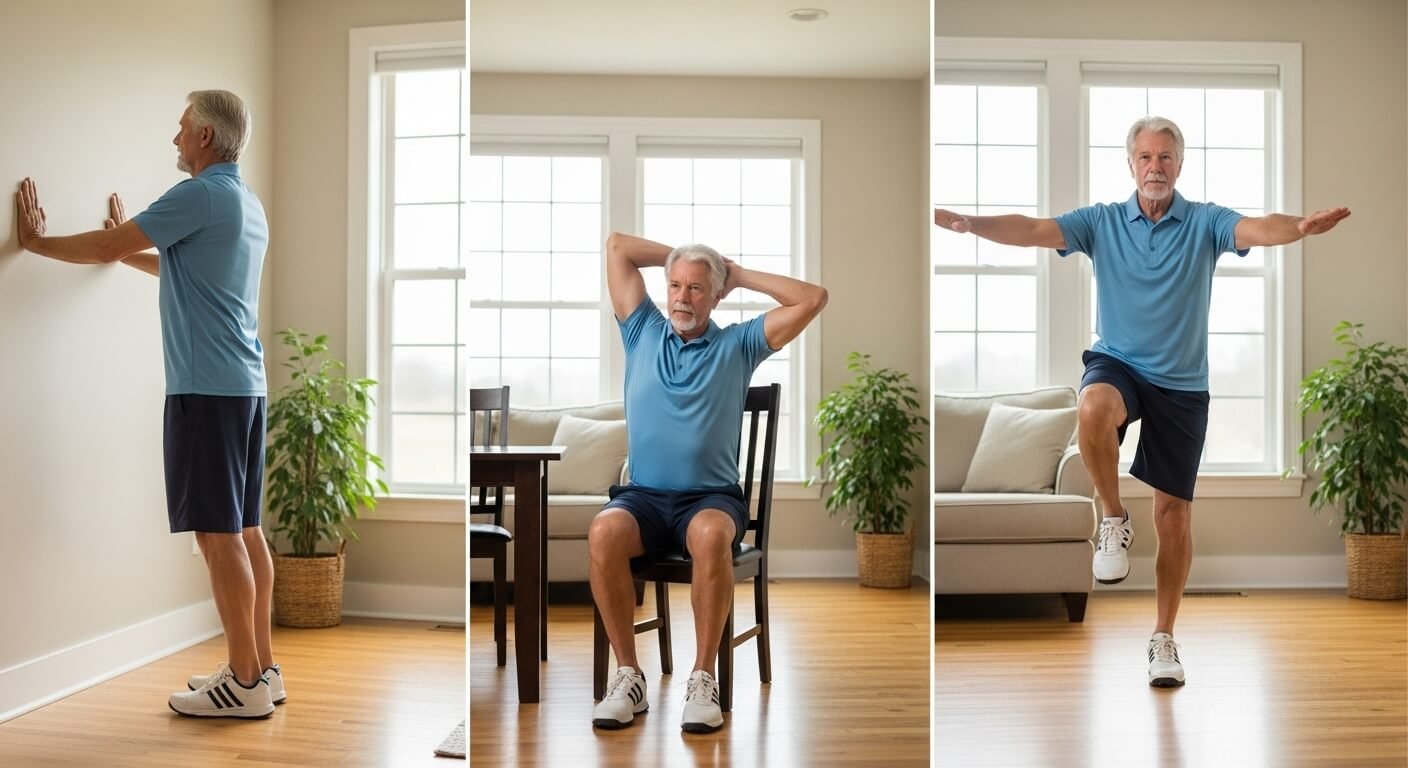
Duration: Hold for 45-60 seconds each leg. Perform 2-3 sets per leg with 15-second rest between sets. Total time: 6-8 minutes.
Golf Benefits: Hip flexors control weight transfer—the foundation of power generation in golf. Tight hip flexors prevent proper weight shift to your back foot during the backswing. They also restrict the forward weight transfer through impact. This stretch restores the hip mobility needed for a proper “bump and turn” move. Your lower body leads the downswing more naturally. Impact position improves dramatically as your hips can clear properly.
Health Benefits: Prolonged sitting shortens hip flexors by up to 10% annually after age 60. This creates anterior pelvic tilt, forcing your lower back into excessive arch. Hip flexor stretching reverses this pattern, reducing lower back pain. Walking stride length increases. Climbing stairs becomes easier. Balance improves because your pelvis returns to neutral position.
Meant For: Senior golfers who sit frequently, experience lower back pain, or notice difficulty with weight transfer during their swing. Players who feel “stuck” on their back foot through impact benefit enormously. Those with anterior pelvic tilt or tight hip flexors from cycling or rowing should prioritize this stretch.
Why It Ranks #2: Hip mobility controls the golf swing’s kinetic chain sequence. Without hip flexibility, power cannot transfer from the ground up through your body to the club. The stretch addresses the second most common physical limitation in senior golfers while being accessible to most fitness levels.
Results Timeline: Week 1-2: Hip mobility improves noticeably during daily activities. Week 3-4: Weight transfer in your golf swing feels more natural. Week 5-6: Consistent improvement in impact position. Week 7-8: Increased clubhead speed becomes measurable.
Performance Impact: Distance gains of 8-15 yards are typical. Ball striking consistency improves by 20-25%. Fat shots decrease significantly as hip clearing allows proper impact position. Your swing feels more athletic and connected.
3. Shoulder Cross-Body Stretch
Detailed Step-by-Step Instructions:
- Stand or sit with your spine in neutral alignment.
- Your shoulders should be level and relaxed, not elevated toward your ears.
- Take your right arm and extend it straight across your chest at shoulder height.
-
Your palm faces away from your body.
-
Use your left hand to grasp your right arm just above the elbow.
- Apply gentle, steady pressure to pull your right arm closer to your chest.
- The stretch occurs across your right shoulder blade and the back of your right shoulder.
-
Your right shoulder should not lift during the stretch—keep both shoulders level.
-
Focus on pulling your arm toward your body, not downward.
- The movement is horizontal, crossing your chest.
- Your right arm remains straight throughout the stretch.
-
Breathe normally and allow the stretch to deepen with each exhale.
-
Maintain the stretch position while keeping your head in neutral alignment.
- Don’t let your head turn toward the stretched arm.
- After completing the right side, switch arms and repeat the sequence.
Duration: Hold for 25-35 seconds each arm. Complete 3 sets per arm with 10-second rest between sides. Total time: 4-5 minutes.
Golf Benefits: This stretch targets the posterior deltoid and infraspinatus muscles—critical for maintaining proper swing plane. Tight shoulder muscles force compensations that cause over-the-top swing patterns. The stretch allows your arms to swing on the proper plane during the backswing. Follow-through improves because your trailing arm can cross your body naturally. Shoulder impingement risk decreases significantly.
Health Benefits: Desk work and driving create rounded shoulder posture, shortening the anterior deltoids while tightening the posterior muscles. This stretch balances that pattern. Reaching overhead becomes easier. Sleep comfort improves as shoulder tension releases. Neck pain often diminishes because shoulder position affects cervical spine alignment.
Meant For: All senior golfers benefit, especially those with desk jobs, previous shoulder injuries, or restricted follow-through. Players who struggle with over-the-top swing patterns should prioritize this stretch. Those experiencing shoulder stiffness after golf rounds find significant relief.
Why It Ranks #3: Shoulder mobility directly affects swing plane consistency. While not as impactful as spine or hip mobility, shoulder restrictions create compensations that hurt both distance and accuracy. The stretch is simple enough for daily use while addressing a major swing limitation.
Results Timeline: Week 1: Immediate relief from shoulder tension. Week 2-3: Improved range of motion becomes noticeable. Week 4-5: Swing plane consistency improves. Week 6-8: Reduced compensation patterns in your swing.
Performance Impact: Swing plane consistency improves by 15-20%. Follow-through feels more natural and complete. Mishits from over-the-top patterns decrease significantly. Your swing feels more connected from backswing to finish.
4. Cat-Cow Spinal Mobility
Detailed Step-by-Step Instructions:
- Position yourself on hands and knees on an exercise mat or carpeted surface.
- Place your wrists directly under your shoulders and your knees directly under your hips.
-
Your fingers spread wide for stability, pointing straight ahead.
-
Begin in neutral spine position—your back should have natural curves, not flat or overly arched.
-
Your head position should allow you to look at the ground about 12 inches in front of your hands.
-
For the “Cow” position: slowly arch your back by tilting your pelvis forward and lifting your chest and head.
- The movement originates from your pelvis, not from forcing your back into extension.
- Your shoulder blades come together naturally.
-
Look forward, not up at the ceiling.
-
For the “Cat” position: reverse the movement by tilting your pelvis backward and rounding your spine toward the ceiling.
- Your head drops naturally, creating a smooth curve from your tailbone to the top of your head.
-
Push gently through your hands to increase the stretch between your shoulder blades.
-
Move slowly between positions, spending 2-3 seconds in each pose.
- The transition should feel fluid, like a wave moving through your spine.
Duration: Perform 12-15 slow repetitions. Hold each position for 3-4 seconds. Total time: 4-5 minutes including setup and transitions.
Golf Benefits: Golf requires maintaining spine angle throughout the swing—something that becomes increasingly difficult with age. This exercise mobilizes all segments of your spine, improving your ability to maintain posture at address and through impact. Your ability to rotate around a stable spine improves. Hip hinge movement becomes more natural, improving your setup position.
Health Benefits: Spinal arthritis affects 85% of people over 60. This gentle movement lubricates spinal joints and maintains mobility. Core muscles activate during the movement, providing stability training. Hip flexor tightness often releases as the pelvis moves through its range. Lower back pain from sitting decreases significantly.
Meant For: Senior golfers with spinal stiffness, lower back pain, or difficulty maintaining posture during their swing. Players recovering from back injuries benefit from the gentle nature of this exercise. Those who sit frequently should perform this daily.
Why It Ranks #4: Spinal mobility affects every aspect of the golf swing. While individual segments like thoracic rotation may be more critical, overall spinal health impacts posture, rotation, and power transfer. The exercise addresses multiple spinal segments simultaneously.
Results Timeline: Week 1: Immediate improvement in spinal stiffness. Week 2-3: Better posture maintenance during daily activities. Week 4-5: Improved ability to maintain spine angle during golf swing. Week 6-8: Reduced back fatigue after golf rounds.
Performance Impact: Consistency improves as posture becomes more stable. Ball striking becomes more solid as spine angle maintenance improves. Fatigue during long rounds decreases significantly. Your swing feels more repeatable.
5. Seated Spinal Twist
Detailed Step-by-Step Instructions:
- Sit in a sturdy chair with a firm back.
- Your feet should be flat on the floor, hip-width apart.
- Sit toward the front edge of the seat to allow for full rotation.
-
Your back should be straight but not rigid against the chair back.
-
Place your right hand on the outside of your left knee.
- Your left hand goes behind you, either on the chair back or armrest for support.
-
This hand position provides leverage for the rotation.
-
Begin the twist by turning your ribcage to the left while keeping your hips facing forward.
- The rotation comes from your thoracic spine, not from forcing your neck to turn.
- Your eyes follow the movement naturally.
-
Feel the stretch along your right side and across your mid-back.
-
Maintain the twist while breathing normally.
- Each exhale allows you to rotate slightly further, but never force the movement.
-
Your lower body remains stable throughout the exercise.
-
After completing the left rotation, reverse your hand positions and rotate to the right side.
Duration: Hold each rotation for 30-40 seconds. Perform 2-3 sets in each direction with 15-second rest between sides. Total time: 5-6 minutes.
Golf Benefits: Seated rotation is safer for seniors with balance issues while still improving the spinal mobility needed for golf. The exercise specifically targets thoracic rotation while providing stability through the lower body. Your ability to separate upper and lower body movement improves—critical for proper swing sequence.
Health Benefits: Spinal rotation maintains disc health by promoting nutrient exchange. Digestive function often improves with spinal twisting movements. Hip flexors stretch gently during the exercise. Core muscles activate to control the rotational movement.
Meant For: Senior golfers with balance concerns, those who prefer seated exercises, or players recovering from lower body injuries. This variation works well for those with knee or ankle limitations.
Why It Ranks #5: While spinal rotation is critical for golf, the seated position limits the effectiveness compared to standing or kneeling variations. However, the safety and accessibility make it valuable for seniors who cannot perform more challenging exercises.
Results Timeline: Week 1-2: Improved spinal mobility during daily activities. Week 3-4: Better separation of upper and lower body during golf swing. Week 5-6: Increased comfort with rotational movements. Week 7-8: More consistent swing tempo.
Performance Impact: Swing sequence improves as upper/lower body separation develops. Tempo becomes more consistent. Over-the-top patterns decrease. Your swing feels more controlled and repeatable.
6. Standing Forward Fold (Modified)
Detailed Step-by-Step Instructions:
- Stand with your feet hip-width apart, arms hanging naturally at your sides.
- Engage your core muscles gently to support your lower back.
-
Check that your weight is evenly distributed between both feet.
-
Begin by softening your knees slightly—they don’t need to be locked straight.
- Place your hands on your hips and begin to hinge forward from your hip joints, not your waist.
-
The movement should feel like you’re pushing your hips backward while your torso tips forward.
-
Let your arms hang naturally as you fold forward.
- Go only as far as feels comfortable—this might be just 30-45 degrees for some seniors.
- Never force the stretch or try to reach the ground.
-
The goal is to feel a gentle stretch along your hamstrings and lower back.
-
Keep your head in neutral alignment with your spine.
- Don’t let it hang heavily or crane your neck to look forward.
-
Breathe deeply throughout the stretch.
-
To return to standing, reverse the movement by pushing your hips forward and lifting your torso.
- You can place your hands on your thighs for support during the return movement.
Duration: Hold for 20-30 seconds. Perform 2-3 repetitions with 10-second rest between reps. Total time: 3-4 minutes.
Golf Benefits: Hip hinge movement is fundamental to golf setup and swing mechanics. This stretch improves your ability to maintain proper posture at address. Hamstring flexibility allows better spine angle maintenance throughout the swing. The movement pattern reinforces proper hip hinge mechanics used in the golf swing.
Health Benefits: Hamstring tightness contributes to lower back pain by tilting the pelvis posteriorly. This stretch helps maintain proper pelvic alignment. Blood flow to the legs improves. Spinal decompression occurs as gravity assists the stretch.
Meant For: Senior golfers with adequate balance and no severe back issues. Players who struggle with setup posture or maintaining spine angle benefit significantly. Those with tight hamstrings from sitting should incorporate this stretch.
Why It Ranks #6: Hip hinge mechanics are crucial for golf, but the exercise requires good balance and can be challenging for seniors with back issues. The benefit is significant for those who can perform it safely.
Results Timeline: Week 1-2: Improved hamstring flexibility during daily activities. Week 3-4: Better setup posture at address. Week 5-6: Improved spine angle maintenance during swing. Week 7-8: Reduced lower back fatigue after golf.
Performance Impact: Setup position becomes more consistent. Ball striking improves as spine angle is maintained better. Lower back fatigue decreases during long rounds. Your swing feels more athletic and stable.
7. Wall Chest Stretch
Detailed Step-by-Step Instructions:
- Stand approximately 18 inches away from a solid wall.
- Your feet should be parallel to the wall, shoulder-width apart for stability.
-
Face the wall with your body perpendicular to it.
-
Extend your right arm and place your palm flat against the wall at shoulder height.
- Your arm should be straight but not locked.
-
Your fingers point upward, and your entire palm contacts the wall surface.
-
Step forward with your left foot while keeping your right palm pressed firmly against the wall.
- The forward step creates the stretch across your right chest and front shoulder.
-
Take small steps initially—you don’t need to step far to feel the stretch.
-
Keep your right shoulder down and back.
- Don’t allow it to roll forward or elevate toward your ear.
- Your torso should remain upright, not leaning into the wall.
-
The stretch should feel gentle but noticeable across your chest and front deltoid.
-
Hold the position while breathing normally.
- Your chest muscles lengthen with each exhale.
- After completing the right side, turn around and repeat with your left arm against the wall.
Duration: Hold for 35-45 seconds each side. Perform 2 sets per arm with 10-second rest between sides. Total time: 4-5 minutes.
Golf Benefits: Tight chest muscles pull your shoulders forward, restricting your ability to get your arms behind you during the backswing. This stretch opens the chest, allowing better arm positioning throughout the swing. Your ability to extend through impact improves significantly. Posture at address becomes more upright and athletic.
Health Benefits: Modern life creates shortened chest muscles from driving, computer work, and general forward posture. This stretch counteracts those patterns. Breathing capacity increases as the ribcage opens. Neck pain often decreases as shoulder position improves. Upper back muscles can function better when chest tightness releases.
Meant For: Senior golfers with rounded shoulders, forward head posture, or restricted backswing. Office workers and frequent drivers benefit significantly. Players who feel “tight” across their chest during the swing should prioritize this stretch.
Why It Ranks #7: Chest flexibility is important for posture and arm positioning, but it’s less critical than spinal or hip mobility for golf performance. The stretch is simple and effective but addresses a secondary limitation.
Results Timeline: Week 1: Immediate improvement in posture awareness. Week 2-3: Noticeable increase in chest flexibility. Week 4-5: Better arm positioning during backswing. Week 6-8: Improved extension through impact position.
Performance Impact: Posture at address improves noticeably. Backswing feels less restricted. Extension through impact becomes more natural. Your swing appears more upright and athletic.
8. Ankle Circles
Detailed Step-by-Step Instructions:
- Sit in a sturdy chair or stand near a wall or stable surface for balance support.
- If standing, place one hand on the support surface.
-
Lift your right foot 2-3 inches off the ground, keeping your leg relatively straight.
-
Begin making slow, controlled circles with your ankle.
- Start with small circles and gradually increase the size as your ankle warms up.
-
Focus on moving only your ankle joint—your lower leg should remain relatively still.
-
Make 10 circles in a clockwise direction, then 10 circles counterclockwise.
- The movement should be smooth and continuous, not jerky or forced.
-
You may hear gentle popping or cracking sounds—this is normal joint movement.
-
After completing circles in both directions, flex your ankle up toward your shin, then point your toes away from you.
-
Repeat this flexion and extension movement 10 times.
-
Switch to your left foot and repeat the entire sequence.
- Pay attention to differences between your ankles—one side may be tighter or less mobile than the other.
Duration: 10 circles each direction, 10 flexion/extension movements per foot. Complete 2 sets per foot. Total time: 3-4 minutes.
Golf Benefits: Ankle mobility affects your ability to maintain balance throughout the swing. Proper weight distribution during the swing requires mobile ankles. The exercise improves your ability to “feel” the ground during your swing, enhancing stability and power transfer.
Health Benefits: Ankle mobility is crucial for safe walking and fall prevention. The exercise improves circulation in the lower legs. Stiffness from prolonged sitting decreases. Balance reactions improve, reducing fall risk during daily activities.
Meant For: All senior golfers, especially those with balance concerns or stiff ankles from prolonged sitting. Players who feel unsteady during their swing or have difficulty with weight transfer benefit from improved ankle mobility.
Why It Ranks #8: Ankle mobility is important for balance and stability, but has less direct impact on golf swing mechanics compared to spine, hip, and shoulder mobility. The exercise is valuable for overall stability and injury prevention.
Results Timeline: Week 1: Immediate improvement in ankle range of motion. Week 2-3: Better balance during daily activities. Week 4-5: Improved stability during golf swing. Week 6-8: Enhanced weight transfer capabilities.
Performance Impact: Balance during the swing improves noticeably. Weight transfer feels more controlled. Stability on uneven lies improves. Your overall athleticism on the course increases.
9. Neck Side Stretch
Detailed Step-by-Step Instructions:
- Sit or stand with your spine in neutral alignment.
- Your shoulders should be relaxed and level, not elevated or rolled forward.
-
Place your hands at your sides or in your lap if sitting.
-
Slowly tilt your head to the right, bringing your right ear toward your right shoulder.
- The movement should be purely sideways—don’t let your head rotate or tilt forward.
-
Your left shoulder should remain down and relaxed.
-
If you want to increase the stretch gently, place your right hand on the left side of your head.
- Apply very light pressure—your hand’s weight is often enough.
-
Never pull or force the stretch.
-
You should feel the stretch along the left side of your neck and possibly into your left shoulder.
- The sensation should be comfortable, never sharp or painful.
-
If you experience any tingling or numbness, reduce the stretch immediately.
-
Breathe normally throughout the stretch.
- Your neck muscles lengthen with each exhale.
- After completing the right side, return your head to neutral and repeat to the left side.
Duration: Hold for 20-25 seconds each side. Perform 2-3 sets per side with 5-second rest between sides. Total time: 3-4 minutes.
Golf Benefits: Neck tension affects head position during the swing. Tight neck muscles can cause unwanted head movement during the swing, leading to inconsistent ball striking. This stretch helps maintain stable head position throughout the swing sequence.
Health Benefits: Neck stiffness is extremely common in seniors due to poor posture, sleeping positions, and stress. This stretch provides immediate relief. Headaches related to neck tension often decrease. Range of motion for daily activities like driving improves significantly.
Meant For: Senior golfers with neck stiffness, tension headaches, or those who spend significant time reading or at computers. Players who notice head movement during their swing benefit from reduced neck tension.
Why It Ranks #9: While neck flexibility is important for comfort and head stability, it has minimal direct impact on golf swing mechanics compared to larger joints. The stretch provides valuable relief but doesn’t significantly affect swing performance.
Results Timeline: Week 1: Immediate relief from neck tension. Week 2: Improved range of motion for daily activities. Week 3-4: Reduced neck fatigue after golf rounds. Week 5-8: Better head position consistency during swing.
Performance Impact: Head position during swing becomes more stable. Neck fatigue during long rounds decreases. Overall comfort during golf improves. Your ability to maintain focus throughout the round increases.
10. Calf Stretch Against Wall
Detailed Step-by-Step Instructions:
- Stand facing a solid wall, approximately arm’s length away.
- Place both palms flat against the wall at shoulder height, shoulder-width apart.
-
Your arms should be straight but not locked.
-
Step your right foot back 2-3 feet from the wall while keeping your left foot closer to the wall.
-
Both feet should point straight toward the wall, not turned inward or outward.
-
Keep your right leg straight and press your right heel firmly into the ground.
- Lean forward into the wall by bending your left knee and shifting your weight forward.
-
You should feel the stretch in your right calf muscle.
-
Your back leg should remain straight throughout the stretch—bending your knee reduces the effectiveness.
-
If you don’t feel a sufficient stretch, step your back foot further from the wall.
-
Maintain steady pressure through your hands against the wall to control the stretch intensity.
- After completing the right leg, switch positions and stretch your left calf.
Duration: Hold for 40-50 seconds each leg. Perform 2 sets per leg with 15-second rest between legs. Total time: 5-6 minutes.
Golf Benefits: Calf flexibility affects your ability to maintain balance during the swing. Tight calves can restrict ankle mobility, which impacts weight transfer and balance. The stretch improves your ability to “stay down” through impact.
Health Benefits: Calf tightness is common in seniors due to reduced activity levels and prolonged sitting. This stretch helps prevent calf cramps during walking or golf. Circulation in the lower legs improves. Achilles tendon flexibility increases, reducing injury risk.
Meant For: Senior golfers who walk the course, experience calf tightness, or have balance issues during their swing. Players who get calf cramps during or after golf benefit significantly.
Why It Ranks #10: Calf flexibility is beneficial for walking golfers and overall lower leg health, but has limited direct impact on golf swing mechanics. The stretch is valuable for comfort and injury prevention rather than performance enhancement.
Results Timeline: Week 1-2: Improved calf flexibility during walking. Week 3-4: Reduced calf tightness after golf rounds. Week 5-6: Better ankle mobility during golf swing. Week 7-8: Enhanced balance during uneven lies.
Performance Impact: Balance on uneven lies improves. Walking endurance increases for those who walk the course. Lower leg fatigue decreases. Overall stability during the swing enhances slightly.
11. Wrist Circles
Detailed Step-by-Step Instructions:
- Extend both arms in front of you at shoulder height.
- Your elbows should be straight but not locked.
-
Keep your shoulders relaxed and down, not elevated toward your ears.
-
Make slow, controlled circles with both wrists simultaneously.
- Start with small circles and gradually increase the size as your wrists warm up.
-
Focus on smooth, continuous movement rather than speed.
-
Complete 10 circles in a clockwise direction, then 10 circles counterclockwise.
-
The movement should come entirely from your wrist joints—your arms should remain relatively still.
-
After completing the circles, perform wrist flexion and extension.
- Flex your wrists upward, pointing your fingers toward the ceiling, then extend your wrists downward, pointing your fingers toward the floor.
-
Repeat this movement 10-12 times.
-
You may hear gentle popping or clicking sounds from your wrist joints—this is normal joint movement and not cause for concern unless accompanied by pain.
Duration: 10 circles each direction, 10-12 flexion/extension movements. Perform 2-3 sets. Total time: 2-3 minutes.
Golf Benefits: Wrist flexibility is crucial for proper club release through impact. Stiff wrists can prevent proper clubface rotation, leading to slices or hooks. The exercise maintains the wrist mobility needed for consistent ball striking and distance control.
Health Benefits: Wrist stiffness is common in seniors, particularly those with arthritis or repetitive strain from daily activities. This exercise helps maintain range of motion for daily tasks like opening jars, typing, or writing. Circulation in the hands and wrists improves.
Meant For: All senior golfers, especially those with wrist arthritis or stiffness. Players who notice decreased feel in their hands or inconsistent ball striking benefit from improved wrist mobility.
Why It Ranks #11: Wrist mobility is necessary for proper club release and feel, but many seniors can maintain adequate wrist function through golf practice alone. The exercise is valuable but less critical than larger joint mobility.
Results Timeline: Week 1: Immediate improvement in wrist range of motion. Week 2-3: Better feel and control during golf swings. Week 4-5: Improved consistency in ball striking. Week 6-8: Enhanced distance control on shorter shots.
Performance Impact: Ball striking consistency improves moderately. Distance control on wedge shots enhances. Overall feel and touch around the greens increases. Grip comfort during long rounds improves.
12. Standing Quad Stretch
Detailed Step-by-Step Instructions:
- Stand near a wall or sturdy chair that you can use for balance support.
-
Place your left hand on the support surface while standing on your left leg.
-
Bend your right knee and bring your right heel toward your glutes.
- Reach back with your right hand and grasp your right ankle or foot.
-
If you cannot reach your ankle, use a towel or strap to assist.
-
Pull your heel gently toward your glutes while keeping your knees close together.
- Your right knee should point straight down, not out to the side.
-
Keep your pelvis in neutral position—don’t arch your back excessively.
-
The stretch should be felt along the front of your right thigh.
-
If you feel the stretch in your knee joint, ease up on the pull and focus on bringing your heel closer to your glutes rather than pulling harder.
-
Maintain your balance by keeping your left leg slightly bent and your core muscles engaged.
- After completing the right leg, switch positions and stretch your left quadriceps.
Duration: Hold for 30-40 seconds each leg. Perform 2 sets per leg with 10-second rest between legs. Total time: 4-5 minutes.
Golf Benefits: Quadriceps flexibility affects your ability to maintain knee flex during the swing. Tight quads can restrict hip mobility and affect weight transfer. The stretch helps maintain proper lower body stability throughout the swing.
Health Benefits: Quadriceps tightness can contribute to knee pain and restricted hip mobility. This stretch helps maintain knee joint health and reduces patellofemoral pain. Walking and stair climbing become easier with improved quad flexibility.
Meant For: Senior golfers with good balance who experience tight quadriceps or knee stiffness. Players who sit frequently or have anterior pelvic tilt benefit from this stretch. Those with mild knee arthritis should approach cautiously.
Why It Ranks #12: Quadriceps flexibility is beneficial for overall leg function, but the exercise requires good balance and may be challenging for many seniors. The golf-specific benefits are moderate compared to hip and spine mobility.
Results Timeline: Week 1-2: Improved quadriceps flexibility during daily activities. Week 3-4: Better knee comfort during golf rounds. Week 5-6: Enhanced lower body stability during swing. Week 7-8: Improved weight transfer capabilities.
Performance Impact: Lower body stability during swing improves moderately. Knee comfort during long rounds increases. Weight transfer feels more controlled. Overall leg function enhances.
13. Seated Hamstring Stretch
Detailed Step-by-Step Instructions:
- Sit on the front edge of a sturdy chair with your back straight.
-
Your left leg should be bent with your foot flat on the floor, knee at approximately 90 degrees.
-
Extend your right leg straight in front of you with your heel on the ground and your toes pointing toward the ceiling.
-
Your right leg should be as straight as possible without causing knee discomfort.
-
Place your hands on your left thigh for support.
- Slowly lean forward from your hips, not your waist, keeping your back straight.
-
The movement should feel like you’re reaching your chest toward your right knee.
-
You should feel the stretch along the back of your right thigh.
- If you also feel it in your calf, that’s normal and beneficial.
-
Never bounce or force the stretch—hamstring muscles respond better to sustained, gentle pressure.
-
Maintain the forward lean while breathing normally.
-
Your hamstring muscles lengthen with each exhale.
- After completing the right leg, switch positions and stretch your left hamstring.
Duration: Hold for 35-45 seconds each leg. Perform 2-3 sets per leg with 10-second rest between legs. Total time: 5-7 minutes.
Golf Benefits: Hamstring flexibility is crucial for maintaining proper posture at address and throughout the swing. Tight hamstrings force compensatory movements that affect spine angle and balance. This stretch helps maintain the hip hinge position essential for good golf posture.
Health Benefits: Hamstring tightness contributes to lower back pain by affecting pelvic position. This seated variation is safer for seniors with balance issues while still providing effective hamstring lengthening. Daily activities like bending over become easier.
Meant For: Senior golfers who prefer seated stretches or have balance concerns. Players with lower back pain related to hamstring tightness benefit significantly. Those who spend long periods sitting should perform this stretch daily.
Why It Ranks #13: While hamstring flexibility is important for golf posture, the seated variation is less effective than standing versions. However, it’s accessible to seniors who cannot safely perform standing stretches.
Results Timeline: Week 1-2: Improved hamstring flexibility during daily activities. Week 3-4: Better posture maintenance at golf address position. Week 5-6: Reduced lower back tension after golf. Week 7-8: Enhanced spine angle consistency during swing.
Performance Impact: Setup posture becomes more consistent. Spine angle maintenance improves moderately. Lower back fatigue during rounds decreases. Overall postural stability enhances.
14. Arm Circles
Detailed Step-by-Step Instructions:
- Stand with your feet shoulder-width apart and your arms extended straight out to your sides at shoulder height.
- Your palms should face downward initially.
-
Keep your shoulders relaxed and down, not elevated.
-
Begin making small circles with your entire arm, starting with circles about 6 inches in diameter.
- The movement should come from your shoulder joint, with your entire arm moving as one unit.
-
Keep your arms straight but not rigid.
-
Make 10 small circles moving forward, then gradually increase the circle size to medium (12-inch diameter) for another 10 repetitions.
-
Finish with 10 large circles (18-24 inch diameter) if comfortable.
-
Reverse the direction and repeat the sequence backward—large circles first, then medium, then small.
-
The backward direction often feels more challenging, so start conservatively.
-
Throughout the exercise, maintain good posture with your core engaged.
- If your shoulders fatigue quickly, reduce the number of repetitions or circle size.
Duration: 10 repetitions each size (small, medium, large) in each direction. Total of 60 arm circles per session. Complete in 3-4 minutes including rest periods.
Golf Benefits: Arm circles prepare the shoulder joints for the rotational demands of the golf swing. The exercise promotes synovial fluid production, which lubricates the shoulder joints for smoother movement. Your ability to lift your arms overhead during the backswing improves. Shoulder endurance increases, reducing fatigue during longer practice sessions.
Health Benefits: Shoulder joints lose mobility rapidly with disuse—this exercise maintains functional range of motion. Blood circulation to the shoulder muscles increases significantly. The movement pattern helps prevent frozen shoulder syndrome, common in seniors. Daily activities like reaching into cabinets become easier.
Meant For: All senior golfers as a warm-up exercise before practice or play. Players with mild shoulder stiffness or those recovering from shoulder injuries benefit from the gentle, progressive nature of the movement.
Why It Ranks #14: Arm circles provide valuable shoulder preparation but create minimal lasting flexibility improvements. The exercise functions more as a warm-up than a flexibility enhancement tool. Benefits are immediate but temporary.
Results Timeline: Immediate warming and mobility effects during the exercise session. Week 1-2: Shoulders feel less stiff before golf activities. Week 3-4: Reduced shoulder fatigue during practice. No significant long-term flexibility gains expected.
Performance Impact: Shoulders feel more prepared for golf activities. Initial swing stiffness decreases. Warm-up time before full swings reduces. Overall shoulder comfort during golf improves temporarily.
15. Finger Extensions
Detailed Step-by-Step Instructions:
- Sit or stand comfortably with your arms relaxed at your sides.
- Bring both hands up to chest level where you can easily see them.
-
Make tight fists with both hands, tucking your thumbs inside your fingers.
-
Slowly open both hands simultaneously, extending all fingers and thumbs as wide as possible.
- Spread your fingers apart actively—don’t just let them relax open.
-
Your palms should be flat with fingers pointing in different directions.
-
Hold the extended position for 3-4 seconds, feeling the stretch across your palms and between your fingers.
-
Focus on making your hands as wide as possible during the hold.
-
Close your hands back into fists slowly and deliberately.
- The closing motion should be controlled, not rapid.
-
Squeeze your fists firmly for 1-2 seconds before beginning the next repetition.
-
Pay attention to any fingers that don’t extend fully or feel stiff during the movement.
- These areas may need additional attention or indicate early arthritis development.
Duration: 12-15 repetitions of open/close cycle. Perform 2-3 sets with 30-second rest between sets. Total time: 2-3 minutes.
Golf Benefits: Finger and hand flexibility maintains consistent grip pressure throughout the swing. Stiff fingers can cause grip tension, which restricts clubhead speed and feel. The exercise helps maintain the fine motor control needed for consistent ball striking and putting touch.
Health Benefits: Hand arthritis affects 85% of people over 65. This exercise maintains joint mobility and can slow progression of stiffness. Daily activities like opening jars, writing, or buttoning clothes become easier. Circulation to the hands improves significantly.
Meant For: Senior golfers with hand arthritis, grip strength concerns, or finger stiffness. Players who experience hand fatigue during long rounds or practice sessions benefit from improved hand endurance.
Why It Ranks #15: Hand mobility is necessary for golf but represents the smallest impact on overall performance. Most golfers maintain adequate hand function through regular play. The exercise addresses a minor limitation for most players.
Results Timeline: Week 1: Immediate improvement in hand mobility and comfort. Week 2-3: Reduced hand stiffness during daily activities. Week 4-5: Better grip consistency during golf. Long-term: Potential slowing of arthritis progression.
Performance Impact: Grip consistency improves marginally. Hand fatigue during long rounds decreases slightly. Putting touch may enhance due to better finger sensitivity. Overall impact on golf performance remains minimal.
Final Ranking Perspective: These exercises target the physical limitations that most severely impact senior golf performance. The top-ranked stretches address major joint mobility that directly translates to swing improvements and distance gains. Lower-ranked exercises provide comfort and injury prevention benefits but have minimal impact on actual golf performance. Focusing daily effort on exercises 1-8 produces the most significant returns for time invested. The remaining exercises serve as supplemental work for specific issues or maintenance of general flexibility.
Performance improvements become measurable within 4-6 weeks of consistent daily practice. Distance gains of 15-25 yards are realistic for seniors who address their primary mobility limitations through targeted stretching. The task lies in consistency rather than intensity—gentle daily work produces better results than aggressive weekly sessions.