The Rise of Golf Simulators: Bringing World-Class Courses to Your Doorstep

Golf simulators have turned garages, basements, and spare bedrooms into gateways for playing some of the most famous courses on earth — without a plane ticket, a tee time, or even decent weather. Think about that for a second. Ten years ago, "simulator golf" meant a grainy screen and a swing that felt nothing like the real thing. Not anymore.
The technology got better. A lot better. Radar and camera systems that used to live exclusively in TrackMan trailers on the PGA Tour now sit in home setups for a few thousand dollars — sometimes less. And the software behind them? It's rendering courses with a level of detail that genuinely surprises first-timers. Ocean spray at Pebble Beach. Wind gusting across the Old Course at St. Andrews. It's not perfect, but it's close enough to fool your brain into playing golf, not a video game.
This shift didn't happen by accident. Winters got old. Range time got expensive. And golfers — the obsessive kind, the ones who'd rather hit balls in a garage at 9 PM than watch TV — started demanding something better than a net and a mat. Simulators answered that call.
So where does that leave you? With more course options, more technology choices, and honestly, more decisions than you probably expected when you started looking into this. Let's get into it.
Benefits of Playing Simulator Golf Courses

Simulator golf gives you year-round access to real courses, instant swing data, and a practice environment that doesn't care what the weather's doing outside. That alone is worth the conversation.
Here's what you actually get:
- Playing in January without frostbite. Snow outside, 72 degrees inside — that's the whole pitch, really.
- Immediate feedback on every swing (ball speed, spin, launch angle — the numbers that actually tell you what happened, not what you think happened)
- Zero pressure from the group behind you. Take your time. Reset. Hit it again.
- A cost-per-round that gets better the more you play, especially once you've covered the initial setup
- Course variety no physical golf club could ever offer — St. Andrews one night, Augusta the next, some fictional tropical layout after that
- A legitimate way to work on your short game and full swing simultaneously, indoors, in your socks if you want
And here's the thing nobody talks about enough: simulators are sneaky good for actually diagnosing swing flaws. You hit a shot, the data pops up, and suddenly that "I don't know why I keep slicing it" mystery isn't a mystery anymore. It's a face angle number staring back at you.
Best Simulator Golf Courses for Improving Your Game
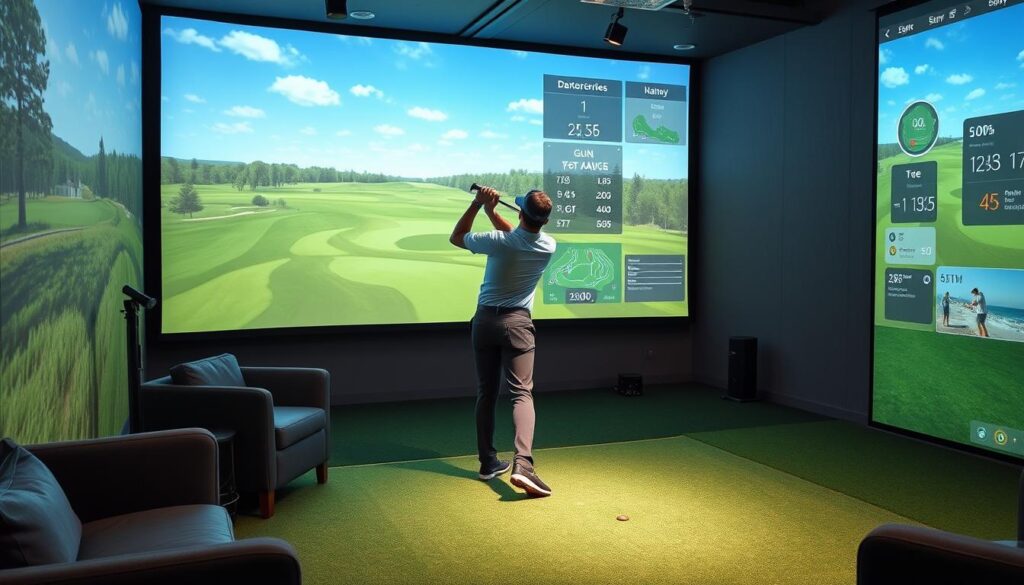
The best simulator golf courses for improving your game combine realistic terrain, varied hole design, and enough challenge to expose weaknesses in your swing — not just pretty scenery.
Not every virtual course pulls double duty as a practice tool. Some are built for the "wow" factor (gorgeous, sure, but forgiving). Others are built like the real venues they're modeled after — tight fairways, brutal rough, greens that punish anything short of precise. If you're trying to get better, not just have fun on a Friday night, you want the second kind.
That's exactly why the six courses below made this list. Each one brings something different to the table, whether that's wind management, precision iron play, or short-game pressure that mirrors tournament golf. Let's go through them.
St. Andrews Old Course: Experience the Home of Golf

St. Andrews Old Course puts you on the most historic layout in golf, and simulator versions capture its blind shots, double greens, and unpredictable bounces better than almost any other course rendering out there.
This course is weird. Genuinely weird, in the best way. Fairways as wide as a football field, sure — but then you've got the Road Hole, the Valley of Sin, pot bunkers deep enough to hide a golf cart. Playing it virtually forces you to think your way around, not just bomb driver and hope. That's a skill a lot of golfers never actually develop, because most modern courses don't demand it.
What makes the simulator version worth your time? The randomness. Real St. Andrews plays differently every single day depending on wind and firmness, and the better software platforms actually simulate that variability instead of giving you the same conditions every round. It teaches shot-shaping and course management in a way flat, static ranges just can't.
If you've never actually understood a golf simulator beyond "screen you hit balls at," this course is a great place to start paying attention to how the tech actually reads your swing and translates it to that unpredictable terrain.
Augusta National Golf Club

Augusta National Golf Club delivers the most recognizable back nine in golf, and simulator renderings focus heavily on its dramatic elevation changes and lightning-fast, undulating greens.
You already know this course, even if you've never played it. Amen Corner. Rae's Creek. That green at 16. Every April, it's on TV, and every April, golfers everywhere wonder what it'd actually feel like to stand on that tee box. Simulator golf is about as close as most of us will ever get.
Here's what stands out on the virtual version:
- Elevation changes that genuinely affect club selection (not just cosmetic — actual yardage and trajectory impact)
- Green complexes modeled with enough detail that putts break the way they're supposed to, which sounds obvious until you've played a simulator course where they don't
- A layout that rewards precise iron play way more than raw distance — good news for shorter hitters, bad news if your only skill is bombing driver
Honestly? Playing Augusta on a simulator won't replicate the roar of the crowd or the azaleas in person. But for practicing approach shots into firm, sloped greens — the exact shot that separates good ball-strikers from great ones — it's tough to beat.
Pebble Beach Golf Links: Coastal Beauty Meets Virtual Reality

Pebble Beach Golf Links puts you on the edge of the Pacific Ocean, and its simulator version is built around wind management and shot precision along those famous cliffside holes.
Holes 7 through 10 at Pebble Beach are some of the most photographed in golf, and for good reason. Ocean on one side, disaster on the other, and barely any room for error. The simulator rendering leans into that — wind gusts pick up unpredictably, and the margin for a mis-hit shrinks fast.
What's actually useful here, practice-wise? Wind reading. A lot of golfers never develop real wind instincts because most ranges are calm, controlled environments. Pebble Beach's virtual version forces you to adjust trajectory and club selection on the fly, which is a skill that transfers directly to actual coastal or windy course play.
Curious how the launch monitor behind your simulator setup is actually reading your ball flight through wind conditions like these? Our guide on what a golf launch monitor actually does breaks down the sensor tech in plain language.
Royal St. George's: England's Premier Links Course
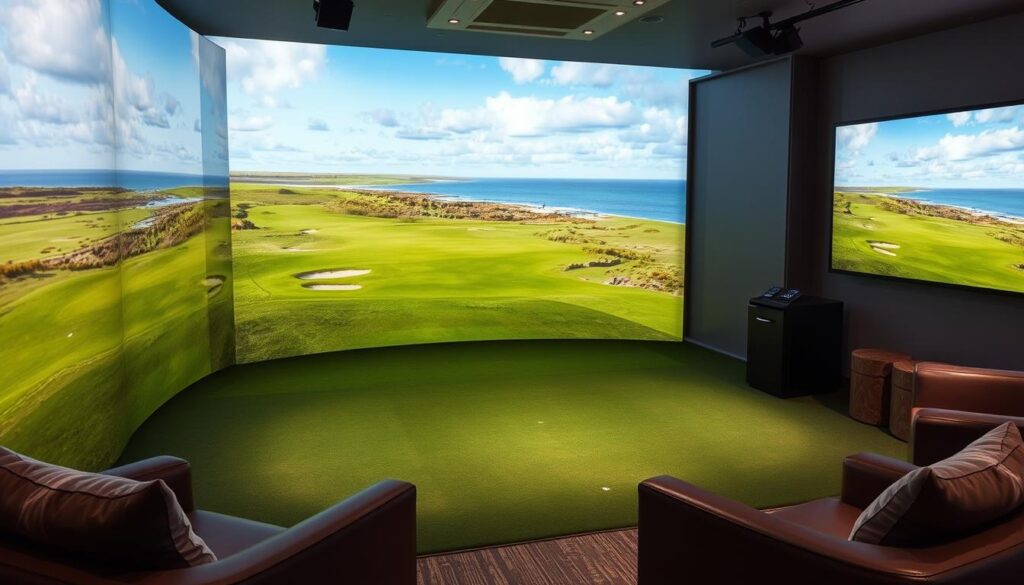
Royal St. George's throws you into true links golf, and its simulator rendering emphasizes uneven lies, deep bunkers, and the low, running shots that classic English seaside courses demand.
This one plays nothing like an American parkland course, and that's the point. Firm turf. Bumpy fairways. Bunkers with faces so steep they might as well be walls. If your game is built entirely around high, soft-landing approach shots, Royal St. George's is going to expose that fast.
A few things worth knowing before you tee off virtually:
- Wind is a constant factor, not an occasional one — it's baked into nearly every hole
- Ball flight control matters more than raw power here; low punch shots often outperform high, showy ones
- Green complexes are firm and fast, which means aggressive approach shots frequently get punished
Links golf teaches shot-making in a way that a lot of modern American golf simply doesn't. And if you're shopping for the actual hardware behind a setup like this, our golf launch monitor buying guide walks through what to look for depending on your space and budget.
Wentworth Club West Course: A Taste of European Tour Excellence

Wentworth Club West Course brings European Tour-style golf into your simulator, with tree-lined fairways and strategic bunkering that reward accuracy over aggression.
This is the "thinking golfer's" course on this list. Wentworth doesn't punish you with ocean carries or blind tee shots the way some of the others do — instead, it grinds you down with tight corridors and well-placed hazards that make every decision matter. Miss the fairway here, and you're often chipping out sideways instead of going for the green.
It's a genuinely underrated course for simulator practice, mostly because it forces discipline. You can't just grip it and rip it. You've got to actually plan your way around 18 holes, club by club, shot by shot.
PGA National: Tackling the Infamous "Bear Trap"

PGA National throws simulator golfers straight into the Bear Trap — holes 15 through 17 — where water hazards and swirling wind combine to make three of the most nerve-wracking consecutive holes in professional golf.
You've probably watched pros unravel here during actual PGA Tour events. Water left, water right, wind that never seems to blow the same direction twice. It's brutal. And playing it virtually gives you a legitimate taste of tournament-level pressure golf, minus the actual tournament.
What makes this stretch valuable for improvement? Pressure putting and precise iron distances. There's very little room for a mediocre shot on any of these three holes, which means every swing carries weight — even in a simulator, your brain treats it that way. That's a mental training benefit a lot of golfers overlook entirely.
Royal Portrush Dunluce Links: Northern Ireland's Golfing Gem

Royal Portrush Dunluce Links delivers dramatic dune-lined fairways and coastal wind, and its simulator version is one of the more physically demanding renderings in terms of shot variety required per round.
Rolling dunes. Blind tee shots. Fairways that seem to disappear into the horizon before curving back. Royal Portrush isn't subtle — it's one of the more visually dramatic courses you can play virtually, and it backs that up with genuinely difficult, wind-affected golf.
This course rewards versatility. You'll need a stinger off the tee on some holes and a full driver on others. Short punch shots into the wind, high soft landers when it's calm. If your simulator sessions have gotten repetitive — same shots, same clubs, same predictable results — Royal Portrush breaks that pattern fast.
Exotic Locations: Golfing Around the World from Your Simulator

Simulator golf lets you play courses in locations most golfers will genuinely never visit in person, from Caribbean island layouts to mountain courses carved into terrain that would be nearly impossible to build (or reach) in real life.
This is where simulator golf gets a little indulgent, honestly. Tropical courses with turquoise water hugging every fairway. Mountain layouts with elevation drops that would make your ears pop on a real course. Desert courses framed by red rock formations. None of it is strictly "practice" in the traditional sense — but it's fun, and fun keeps you coming back to the simulator during months when you'd otherwise be avoiding golf entirely.
That matters more than people give it credit for. A golfer who plays simulator golf twelve months a year, even casually, is going to retain more swing consistency than someone who puts the clubs away every November. Curious whether outdoor golf is even an option where you live during the colder months? Check out our breakdown of year-round golfing and how simulators fit into that picture.
TrackMan Technology: Enhancing Your Virtual Golfing Experience
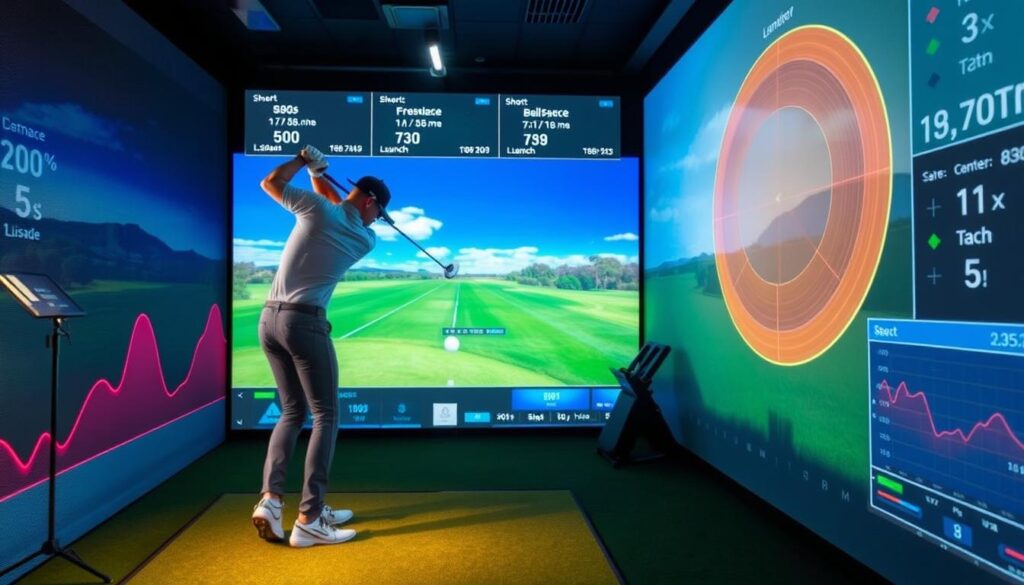
TrackMan technology uses dual radar tracking to measure both club and ball data with a level of precision that's become the benchmark every other launch monitor gets compared against.
Look, there's a reason PGA Tour players trust this stuff. TrackMan doesn't estimate — it measures. Actual radar tracking the actual ball and club through actual space, not an algorithm guessing based on limited data points. That's a meaningful difference if you're trying to genuinely dial in your numbers instead of just getting a rough idea.
| What TrackMan tracks | Why it matters |
|---|---|
| Club path & face angle | Tells you exactly why the ball is curving (not just that it is) |
| Spin rate & axis | Explains shot shape and how the ball behaves on landing |
| Smash factor | Shows how efficiently you're transferring energy at impact |
| Attack angle | Huge for driver optimization — steep vs. shallow makes a real difference |
Is TrackMan overkill for a casual golfer just trying to have fun on the weekend? Kind of, yeah. Honestly. But if you're serious about improvement — actually serious, not "I'll get better eventually" serious — the data depth is worth the investment. Pair that data with some actual swing work, and you'll see results faster. Our guide on ways to improve your golf swing is a solid next step once you've got the numbers in front of you.
Tips for Getting the Most Out of Your Simulator Golf Sessions
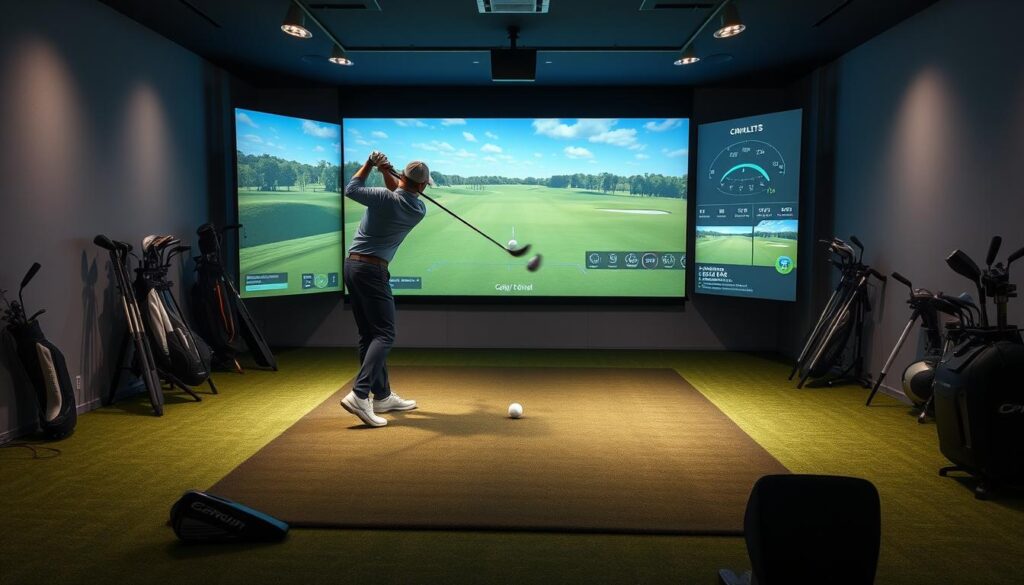
Getting the most out of your simulator golf sessions means treating practice time with intention instead of just mindlessly hitting ball after ball at a screen.
Here's what actually works:
- Warm up before you start. Cold muscles hitting full-speed drives is a recipe for bad data and bad habits.
- Don't ignore the short game. Simulators are great for full swing, but putting and chipping practice gets skipped way too often. Don't skip it.
- Track your sessions over time. One good round means nothing. Trends over weeks? That's where the real insight lives.
- Play actual rounds sometimes, not just range mode. Course management skills only develop when there's a scorecard on the line, even a virtual one.
- Mix up your course selection. Playing the same layout every single session gets stale fast, and it stops challenging you the way it did the first ten times.
And here's a nuance worth mentioning — more data isn't automatically better. Some golfers get so buried in numbers (spin axis, attack angle, dynamic loft, on and on) that they forget to just feel the swing. Balance the analytics with actual instinct. Both matter.
The Future of Simulator Golf: What's Next for Virtual Courses?
The future of simulator golf points toward even more realistic course rendering, tighter integration with swing coaching tools, and pricing that keeps getting more accessible for home setups.
Course graphics are only going to get sharper. That's an easy prediction. But the more interesting shift is happening behind the scenes — software platforms are starting to pair launch monitor data with AI-driven coaching feedback in real time, which means the gap between "simulator practice" and "actual lesson with a pro" keeps shrinking.
Multiplayer functionality is also becoming a bigger deal. Playing a full round against a buddy three states away, in real time, with real data on both swings? That's already happening on some platforms, and it's only going to get smoother. Whether that fully replaces a Saturday round with your regular group, who knows. Probably not entirely. But it's changing what "playing golf with friends" even means.
How to Choose the Right Golf Simulator for Your Home
Choosing the right golf simulator for your home comes down to matching your available space, your budget, and how much realism you actually need against what you're willing to spend to get it.
That's the honest framework. Not every golfer needs a $6,000 enclosure with a ceiling-mounted projector. Some genuinely just need a way to hit balls indoors during winter without punching a hole in the wall. Others want the full experience — screen, course library, the works. Figure out which camp you're in before you start shopping, because the price gap between those two ends is enormous.
Matching a Simulator to Your Space and Goals
Small Rooms and Tight Budgets
If you're working with a small room and don't want to spend much, an infrared standalone system covers the basics without needing a separate launch monitor or an enclosure. No net setup required, no screen to mount. Just space to swing and a computer to run it.
Golfers Who Already Have a Hitting Space
Already got a net, a mat, maybe even a spare room dedicated to golf? Then buying a standalone launch monitor and building your own setup around it usually makes more financial sense than paying for a bundled enclosure you don't fully need.
Dedicated Garage or Basement Builds
Got a garage or basement you're willing to convert entirely? A complete studio package — launch monitor, enclosure, screen, and projector all in one order — saves you the hassle of sourcing everything separately and guessing whether the pieces will actually fit together.
How Much Does a Golf Simulator Cost?
A golf simulator costs anywhere from around $500 for a basic infrared setup to $4,500 or more for a complete enclosure studio, and the right number for you depends entirely on which tier from above actually fits your situation.
Let's break down real options at each price point — because "it depends" isn't a helpful answer when you're actually trying to buy something.
Budget Tier: Infrared Standalone Systems (Under $500)
OptiShot 2 Golf Simulator
Price: $499.99
This is the simplest way into simulator golf, period. No separate launch monitor to buy. Sixteen infrared sensors handle the swing tracking, and the whole thing runs off included software.
Features:
- 16 high-speed infrared sensors (48MHz) tracking your swing
- Measures club speed, carry distance, face angle, path, face contact, and tempo
- Comes with 15 real-world golf courses, playable online or offline
- Runs on Windows 8/10/11 — sorry, Mac users, this one's not for you
- Includes mat, USB cable, adjustable tees, foam practice balls
Pros:
- Cheapest complete simulator option on this list, by a wide margin
- Everything you need is in one box — no separate launch monitor purchase
- Small footprint. Works in rooms that wouldn't fit anything bigger.
- Been around long enough that the bugs are mostly worked out
Cons:
- Infrared just isn't as precise as radar or camera tracking — don't expect tour-level numbers
- No spin rate, no launch angle data
- PC only. That's a real limitation for a lot of households these days.
- Want more courses beyond the included 15? That'll cost extra.
Best suited for: Anyone who wants to try simulator golf without a big financial commitment, tight spaces, or golfers who just want something simple that works without a learning curve.
Mid-Range Tier: Launch Monitor + Software Bundles ($1,000–$3,000)
SkyTrak+ Golf Launch Monitor & Simulator Bundle
Price: $2,995 MSRP (frequently discounted)
This one's a standalone launch monitor — dual radar, photometric camera, the whole deal. You bring your own screen and space. SkyTrak+ brings the actual data.
Features:
- Dual Doppler radar plus photometric camera for combined ball and club tracking
- Full metrics: spin, launch angle, shot shape, club path, face angle
- Wi-Fi connectivity for wireless pairing with your setup
- Access to 100,000+ virtual courses through supported software platforms
- Free trial membership included with purchase
Pros:
- Data accuracy that genuinely competes with systems costing way more
- Tiny 2"x2" hitting zone means it fits in rooms an enclosure never could
- Total flexibility — pair it with whatever screen, net, or room setup you've already got
- Big, established user base, which usually means better long-term software support
Cons:
- You're on your own for the enclosure, screen, and projector — none of that's included
- Full course access typically needs an ongoing paid membership
- More setup effort than a plug-and-play box. Worth it, but be aware.
Best suited for: Golfers who already have a hitting space sorted out and want premium-level data without paying for a bundled enclosure they might not need.
Premium Tier: Complete Enclosure Studio Packages ($4,000+)
SkyTrak ST MAX Golf Simulator Standard Studio Package
Price: Starting at $4,495
This is the "everything shows up in one order" option. Launch monitor, enclosure, screen, mat, projector — all of it, bundled.
Features:
- SkyTrak ST MAX launch monitor (dual Doppler radar, photometric cameras)
- Full enclosure, impact screen, and steel frame
- 5×5 premium hitting mat
- ZW350ST short-throw projector for course visuals
- GOLFTEC-powered speed training tools built in
- 14-day free trial membership included
Pros:
- Genuinely complete out of the box — no scrambling to find a compatible screen or projector afterward
- Assembly is manageable. A few hours, two people, no special tools needed.
- Works for lefties and righties both, without extra parts
- Speed training add-on is a legitimate bonus most competitors skip
Cons:
- Real money. This isn't an impulse purchase for most people.
- You'll need actual room dimensions — minimum 10' wide, 8'6" ceiling for the smallest version
- Membership required for full course access once that trial period ends
Best suited for: Golfers with a garage, basement, or bonus room they're ready to convert into a dedicated golf space, and who'd rather order one complete package than piece together components from five different vendors.
Other World-Class Simulator Courses Worth Playing
Beyond the six courses covered in depth above, plenty of other layouts deserve a mention if you're building out your simulator course library.
- Royal Birkdale — Another proper British links course, tight and unforgiving, similar spirit to Royal St. George's but with its own distinct dune structure
- Teeth of the Dog (Dominican Republic) — Pete Dye's Caribbean masterpiece, with several holes running right along the water
- Mission Hills (China) — One of the largest golf resorts on earth, and its simulator rendering captures that scale
- Moonlight Basin (Montana) — Mountain golf with elevation changes that genuinely test club selection and trajectory control
- Bethpage Black — Notoriously difficult, public-access-style course that's hosted multiple major championships and doesn't go easy on anyone, virtual or otherwise
None of these get the same spotlight as St. Andrews or Augusta, but they round out a simulator course library nicely — different terrain, different challenges, different reasons to keep coming back to the screen instead of putting the clubs away for the season.