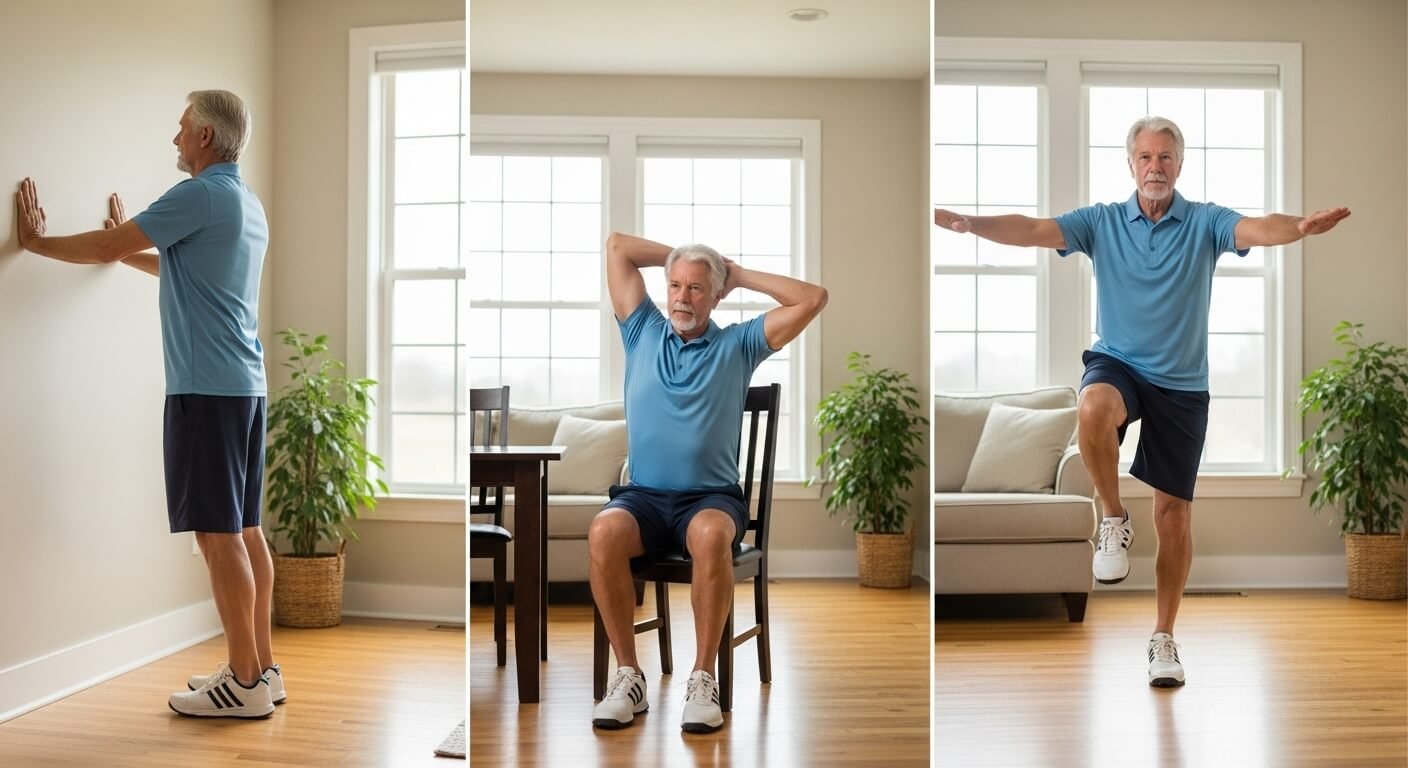
The best golf exercises for senior golfers combine flexibility training, strength development, rotational power work, and balance exercises to maintain swing speed, prevent injury, and improve consistency throughout 18 holes.
Your fitness program should include:
- Flexibility exercises (40% of training time): Spinal rotation, hip mobility, shoulder flexibility, hamstring stretches
- Strength training (35% of training time): Core stability, lower body power, upper body control, functional movements
- Power development (15% of training time): Rotational exercises mimicking your golf swing pattern
- Balance work (10% of training time): Single-leg stability, weight transfer training, proprioceptive challenges
Start with the 15-minute daily routine or 30-minute comprehensive program three times weekly. Consistency matters far more than intensity during your first 8-12 weeks. Focus on learning proper form, moving through pain-free ranges, and establishing sustainable habits.
Track your progress monthly using golf-specific metrics like driving distance, back-nine scoring, and post-round fatigue levels. These concrete measurements provide motivation and demonstrate that your training time translates directly to better golf performance.
Your golf game can—and will—improve at any age when you address the physical components that support swing mechanics. The 65-year-old golfer who trains consistently outperforms the sedentary 55-year-old. The 75-year-old who maintains flexibility and strength plays better golf than untrained 65-year-olds.
Table of Contents
- 1 Understanding the Unique Needs of Senior Golfers
- 2 Essential Components of Golf Fitness for Seniors
- 3 Best Warm-Up Exercises for Senior Golfers
- 4 Top Flexibility Exercises for Senior Golfers
- 5 Best Strength Exercises for Senior Golfers
- 6 Best Rotational Power Exercises for Senior Golfers
- 7 Balance and Stability Exercises for Senior Golfers
- 8 Sample Golf Exercise Routines for Senior Golfers
- 9 Safety Considerations for Senior Golfers Exercising
Understanding the Unique Needs of Senior Golfers
Senior golfers face specific physical challenges that directly impact swing mechanics, distance, and overall performance. Natural aging reduces muscle mass, joint flexibility, and proprioception—the body's ability to sense position and movement in space. These changes manifest as decreased rotation in the backswing, reduced club head speed, and compromised balance during the swing sequence.
Common age-related limitations include:
- Reduced spinal rotation: 30-50% decrease in thoracic mobility after age 60
- Loss of hip mobility: Restricts weight transfer and power generation
- Decreased shoulder flexibility: Limits backswing depth and follow-through
- Balance deficits: Affects stability and weight shift timing
- Muscle atrophy: Reduces power output by 3-5% per decade after 50
Can Exercise Really Improve My Golf Game at 65+?
Exercise absolutely improves golf performance at any age, with research showing senior golfers can increase driving distance by 12-25 yards and reduce scores by 2-4 strokes after 8-12 weeks of golf-specific training.
Documented improvements in senior golfers:
- Club head speed: 3-7 mph increase
- Driving distance: 12-25 yards added
- Balance: 40-60% improvement in single-leg tests
- Flexibility: 20-40% increase in rotation
- Back pain: 50-70% reduction
- Overall scoring: 2-4 strokes lower
Studies from the Titleist Performance Institute show that golfers in their 70s and 80s who follow structured exercise programs perform better than sedentary golfers 10-15 years younger.
What If I Have Limited Mobility?
Golfers with limited mobility should focus on exercises within their current range of motion, using modifications like chair support, reduced repetitions, and assisted movements while gradually expanding capabilities over time. Many golfers with severe initial limitations achieve normal range of motion within 6-12 months through patient, consistent work.
Modifications for limited mobility:
- All standing exercises performed next to chair or counter
- Reduce range of motion by 30-50% initially
- Cut repetitions in half (5-7 instead of 10-15)
- Use lighter resistance or bodyweight only
- Extend rest periods between sets to 2-3 minutes
- Focus on 3-4 exercises per session instead of full routine
Work within pain-free ranges. Discomfort from muscle activation is acceptable; joint pain or sharp sensations indicate you've exceeded current capabilities.
Progressive expansion:
Limited mobility improves with consistent practice:
- Week 1-4: Establish baseline, focus on form
- Week 5-8: Increase range of motion by 10-15%
- Week 9-12: Add 1-2 repetitions per exercise
- Week 13+: Continue gradual progression
Essential Components of Golf Fitness for Seniors
Effective golf training for older adults must address four interconnected fitness domains that directly influence swing performance and injury prevention.
Flexibility and Mobility
Range of motion determines how far you can rotate during your backswing and follow-through. Tight muscles create compensatory movements that strain joints and reduce power transfer. Hip and shoulder mobility work together to create the separation (X-factor) between upper and lower body that generates club head speed.
Strength and Power
Core and lower body strength provide the foundation for every golf swing. Strong legs drive power from the ground up, while core muscles stabilize your spine during rotation. Upper body strength maintains proper arm structure and club control throughout the swing plane.
Balance and Stability
Consistent ball striking requires maintaining your center of gravity over a stable base. Balance training improves proprioception, allowing better weight transfer from backswing to downswing. Enhanced stability also prevents falls on uneven terrain and reduces compensatory movements that cause injury.
Endurance
Walking 18 holes covers 4-6 miles over 4-5 hours. Cardiovascular and muscular endurance prevent fatigue that degrades swing mechanics late in rounds. Better stamina means maintaining proper form from the first tee to the final green.
Best Warm-Up Exercises for Senior Golfers
Warming up before golf prepares your muscles, joints, and nervous system for the explosive rotational movements required in your swing.
Pre-Round Dynamic Stretches
Arm Circles and Shoulder Rolls
This movement increases blood flow to shoulder joints and prepares rotator cuffs for the golf swing's demands.
Benefits: Lubricates shoulder joints, activates rotator cuff muscles, increases shoulder range of motion
Equipment needed: None
Instructions:
- Stand with feet shoulder-width apart
- Extend both arms straight out to the sides
- Make small circles forward for 10 repetitions
- Increase circle size gradually for another 10 repetitions
- Reverse direction and repeat
- Finish with 10 shoulder rolls backward and 10 forward
Torso Rotations with Club
This exercise mimics your golf swing motion while gradually increasing rotational speed and range.
Benefits: Activates core muscles, increases spinal rotation, rehearses swing pattern, raises core temperature
Equipment needed: Any golf club (driver or mid-iron works best)
Instructions:
- Hold a club across your chest with both hands
- Assume your golf stance with knees slightly bent
- Rotate slowly to your backswing position
- Return to center, then rotate to follow-through position
- Complete 10 rotations at 50% speed
- Increase to 75% speed for 10 more repetitions
- Finish with 5 rotations at 90% speed
Hip Circles and Leg Swings
Lower body mobility prevents compensatory movements that stress your lower back during the golf swing.
Benefits: Increases hip mobility, activates stabilizer muscles, improves balance, prepares lower body for weight transfer
Equipment needed: Golf club or wall for balance support
Instructions:
- Stand on one leg, holding a club or wall for balance
- Lift the opposite knee to hip height
- Rotate the lifted leg in circles—10 clockwise, 10 counterclockwise
- Switch legs and repeat
- Face the wall or club for support
- Swing one leg forward and backward 10 times
- Swing the same leg side to side 10 times
- Repeat with opposite leg
Ankle Mobility Exercises
Stable ankles provide the foundation for proper weight transfer and balance throughout your swing.
Benefits: Activates lower leg muscles, improves ankle stability, enhances balance, prepares feet for walking the course
Equipment needed: None
Instructions:
- Stand with feet together
- Lift your right heel, balancing on the ball of your foot
- Hold for 2 seconds, then lower
- Repeat 10 times on each foot
- Draw the alphabet with your toes while standing on one leg
- Complete letters A through J on each foot
Top Flexibility Exercises for Senior Golfers
Flexibility exercises for senior golfers restore and maintain the range of motion required for a full, powerful swing while reducing injury risk.
Shoulder and Upper Back Mobility
Doorway Chest Stretch
Tight chest muscles pull your shoulders forward, restricting backswing rotation and causing poor posture at address.
Benefits: Opens chest muscles, improves shoulder flexibility, promotes better posture, increases backswing rotation by 10-15 degrees
Equipment needed: Doorway or corner wall
Instructions:
- Stand in a doorway with your right arm extended against the door frame at shoulder height
- Position your elbow at 90 degrees
- Step forward with your right foot until you feel a stretch across your chest
- Hold for 30-45 seconds while breathing deeply
- Switch arms and repeat on the left side
- Perform 2-3 repetitions on each side
Seated Spinal Rotation
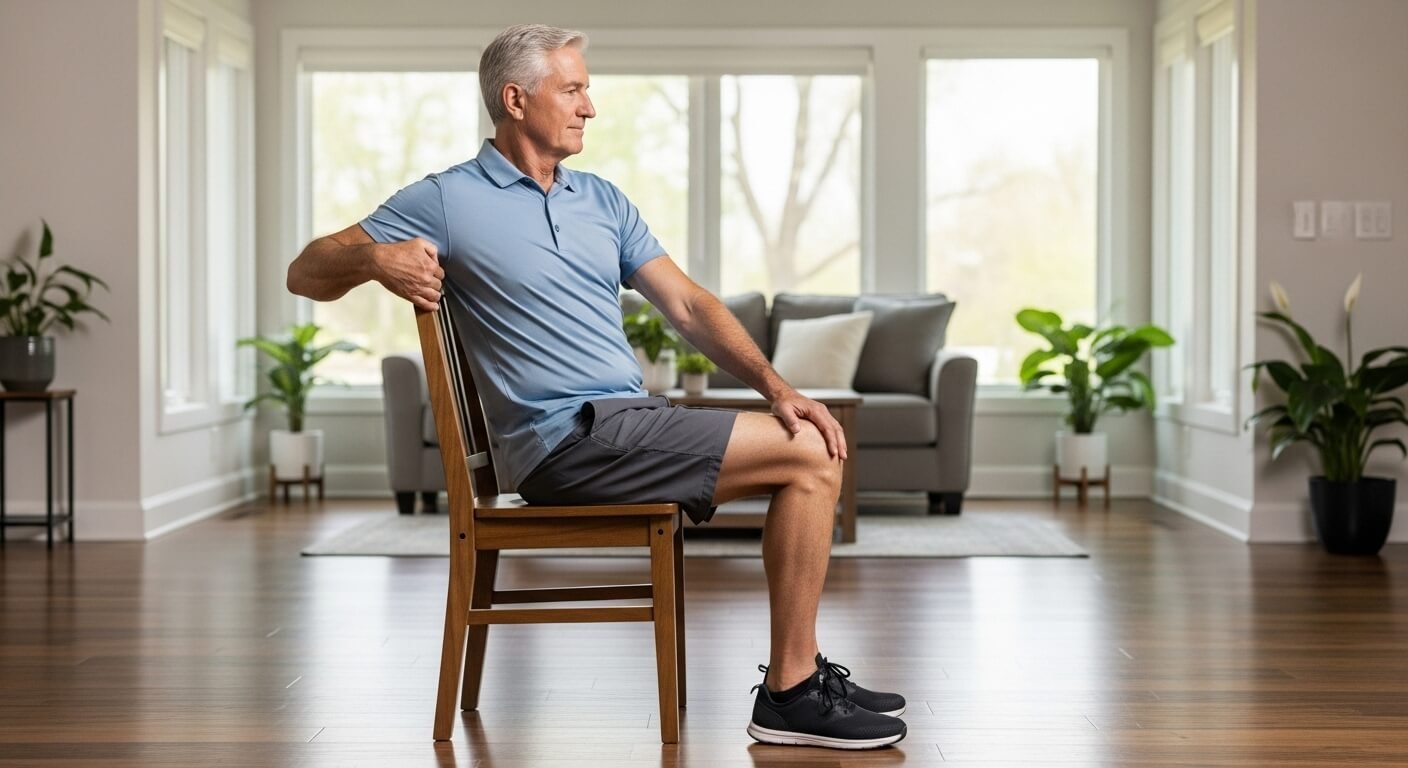
This controlled rotation exercise increases thoracic mobility—the primary source of rotational power in your golf swing.
Benefits: Increases thoracic rotation, reduces lower back strain, improves shoulder turn, adds 5-10 yards to drives
Equipment needed: Sturdy chair without arms
Instructions:
- Sit upright in a chair with feet flat on the floor
- Place your right hand on the outside of your left knee
- Place your left hand on the chair back behind you
- Rotate your torso to the left, using your arms for gentle assistance
- Hold for 20-30 seconds while taking 5 deep breaths
- Return to center and repeat on the opposite side
- Complete 3 repetitions in each direction
Cat-Cow Stretch
This flowing movement pattern mobilizes every segment of your spine while strengthening core stabilizers.
Benefits: Mobilizes entire spine, reduces stiffness, improves body awareness, enhances rotational flexibility throughout the swing
Equipment needed: Yoga mat or soft surface
Instructions:
- Position yourself on hands and knees with wrists under shoulders
- Start in a neutral spine position with your back flat
- Arch your back slowly while lifting your head and tailbone (Cow)
- Hold for 3 seconds
- Round your spine upward while tucking your chin and tailbone (Cat)
- Hold for 3 seconds
- Flow smoothly between positions for 10-12 repetitions
Hip Flexibility Exercises
90/90 Hip Stretch
Hip mobility determines your ability to rotate powerfully while maintaining proper spine angle throughout your swing.
Benefits: Opens hip rotators, increases internal and external rotation, improves weight transfer, reduces lower back compensation
Equipment needed: Yoga mat or carpeted floor
Instructions:
- Sit on the floor with both knees bent at 90-degree angles
- Position your right leg in front with the outer thigh on the ground
- Place your left leg behind with the inner thigh on the ground
- Sit upright with a straight spine
- Lean forward gently over your front leg until you feel a stretch in your right hip
- Hold for 30-40 seconds
- Switch leg positions and repeat on the opposite side
- Perform 2-3 repetitions per side
Standing Hip Flexor Stretch
Tight hip flexors prevent proper hip rotation and force your lower back to compensate during the swing.
Benefits: Lengthens hip flexors, improves hip extension, enhances posture, allows better hip turn in the backswing
Equipment needed: Chair or counter for balance
Instructions:
- Stand next to a chair, holding it for balance
- Step forward with your right foot into a lunge position
- Keep your left knee straight with your left heel on the ground
- Tuck your pelvis slightly under (posterior pelvic tilt)
- Lean forward gently until you feel a stretch in your left hip flexor
- Hold for 30 seconds
- Switch legs and repeat
- Complete 2-3 repetitions on each side
Seated Figure-4 Stretch
This stretch targets hip external rotators that become chronically tight from sitting and walking.
Benefits: Stretches piriformis and hip rotators, reduces sciatic nerve pressure, improves hip mobility for rotation, decreases lower back pain
Equipment needed: Sturdy chair
Instructions:
- Sit near the edge of a chair with feet flat on the floor
- Lift your right ankle and place it on your left knee
- Your right knee should point outward, creating a "4" shape
- Sit upright with a straight back
- Lean forward from your hips (not your waist) until you feel a stretch in your right hip
- Hold for 30-45 seconds
- Switch legs and repeat
- Perform 2-3 repetitions per side
Hamstring and Lower Body Flexibility
Seated Hamstring Stretch
Flexible hamstrings allow you to maintain proper spine angle at address and throughout your swing without rounding your lower back.
Benefits: Lengthens hamstrings, maintains proper posture, reduces lower back strain, improves forward bend ability
Equipment needed: Chair and towel or yoga strap
Instructions:
- Sit near the edge of a chair with your right leg extended straight
- Keep your left foot flat on the floor with knee bent
- Place a towel around the ball of your right foot
- Hold both ends of the towel in your hands
- Sit upright and lean forward from your hips (not your waist)
- Pull gently on the towel until you feel a stretch behind your right thigh
- Hold for 30-40 seconds
- Switch legs and repeat
- Complete 2-3 repetitions per side
Calf Stretches
Tight calves limit ankle mobility, which affects balance and weight transfer during your swing.
Benefits: Increases ankle mobility, improves balance, reduces foot and leg fatigue, enhances stability during weight shift
Equipment needed: Wall or sturdy surface
Instructions:
- Stand facing a wall with hands at shoulder height
- Step your right foot back approximately 2 feet
- Keep your right heel on the ground and right knee straight
- Bend your left knee while leaning toward the wall
- Hold for 30 seconds when you feel a stretch in your right calf
- Bend your right knee slightly to stretch the deeper soleus muscle
- Hold for 30 seconds
- Switch legs and repeat
- Perform 2 repetitions per leg in each position
Best Strength Exercises for Senior Golfers
Strength training for senior golfers builds the muscular foundation required for power generation, injury prevention, and swing consistency.
Core Strengthening Exercises
Dead Bug Exercise
This anti-extension core exercise teaches spinal stability while moving your arms and legs—exactly what happens during your golf swing.
Benefits: Stabilizes spine during rotation, strengthens deep core muscles, improves coordination, prevents lower back hyperextension in the swing
Equipment needed: Yoga mat
Instructions:
- Lie on your back with knees bent at 90 degrees, shins parallel to the floor
- Extend both arms straight up toward the ceiling
- Press your lower back firmly into the mat
- Slowly lower your right arm overhead while extending your left leg
- Stop before your lower back arches off the mat
- Return to starting position
- Repeat with opposite arm and leg
- Complete 8-10 repetitions per side
- Perform 2-3 sets
Bird Dog Exercise
This exercise develops balance and core control by challenging your ability to maintain a neutral spine while moving opposite limbs.
Benefits: Builds core stability, improves balance, strengthens lower back safely, enhances body control during weight transfer
Equipment needed: Yoga mat
Instructions:
- Start on hands and knees with wrists under shoulders
- Engage your core to maintain a flat back
- Extend your right arm forward and left leg backward simultaneously
- Keep your hips level—don't let them rotate
- Hold for 5-10 seconds
- Return to starting position with control
- Repeat with opposite arm and leg
- Complete 8-10 repetitions per side
- Perform 2-3 sets
Pallof Press with Resistance Band
This anti-rotation exercise trains your core to resist unwanted lateral movement during the golf swing.
Benefits: Strengthens obliques, prevents side-to-side sway, improves rotational power transfer, reduces energy leaks in the swing
Equipment needed: Resistance band and anchor point (doorknob or sturdy pole)
Instructions:
- Anchor a resistance band at chest height
- Stand sideways to the anchor point at arm's length distance
- Hold the band with both hands at your chest
- Stand with feet shoulder-width apart, knees slightly bent
- Press your hands straight out from your chest
- The band will try to rotate you—resist this force by keeping your torso stable
- Hold for 3 seconds, then return to chest
- Complete 10-12 repetitions
- Turn around and repeat on the opposite side
- Perform 2-3 sets per side
Modified Planks
Planks build endurance in the core muscles that maintain your spine angle throughout the swing.
Benefits: Builds core endurance, strengthens entire anterior chain, improves posture maintenance, prevents fatigue-related swing breakdowns
Equipment needed: Yoga mat or wall (for wall planks)
Wall Plank (Beginner)
Instructions:
- Stand facing a wall at arm's length
- Place both palms flat against the wall at shoulder height
- Step your feet back until your body forms a straight line
- Engage your core and hold for 20-30 seconds
- Rest and repeat 3-4 times
Knee Plank (Intermediate)
- Start on hands and knees on a mat
- Walk your hands forward until your body forms a straight line from head to knees
- Keep your core engaged—don't let your hips sag
- Hold for 20-40 seconds
- Rest and repeat 3-4 times
Lower Body Strength Exercises
Chair Squats
Lower body strength generates the ground force that translates into club head speed and distance.
Benefits: Strengthens quadriceps, glutes, and hamstrings; improves power generation from the ground; enhances stability; maintains functional independence
Equipment needed: Sturdy chair
Instructions:
- Stand in front of a chair with feet shoulder-width apart
- Position the chair so it will catch you at the bottom of your squat
- Extend your arms forward for balance
- Push your hips back as if sitting down
- Lower until your glutes touch the chair (don't sit down completely)
- Press through your heels to stand back up
- Squeeze your glutes at the top
- Complete 10-15 repetitions
- Perform 2-3 sets
Lateral Lunges (Modified)
Side-to-side strength improves lateral stability and prevents unwanted sway during your swing.
Benefits: Strengthens hip abductors and adductors, improves lateral stability, enhances weight shift control, builds single-leg strength
Equipment needed: Counter or sturdy surface for balance (optional)
Instructions:
- Stand with feet together, holding a counter if needed for balance
- Step your right foot directly to the side (12-18 inches)
- Shift your weight to the right foot while bending the right knee
- Keep your left leg straight
- Push off your right foot to return to the starting position
- Repeat on the left side
- Complete 8-10 repetitions per side
- Perform 2-3 sets
Single-Leg Balance with Reach
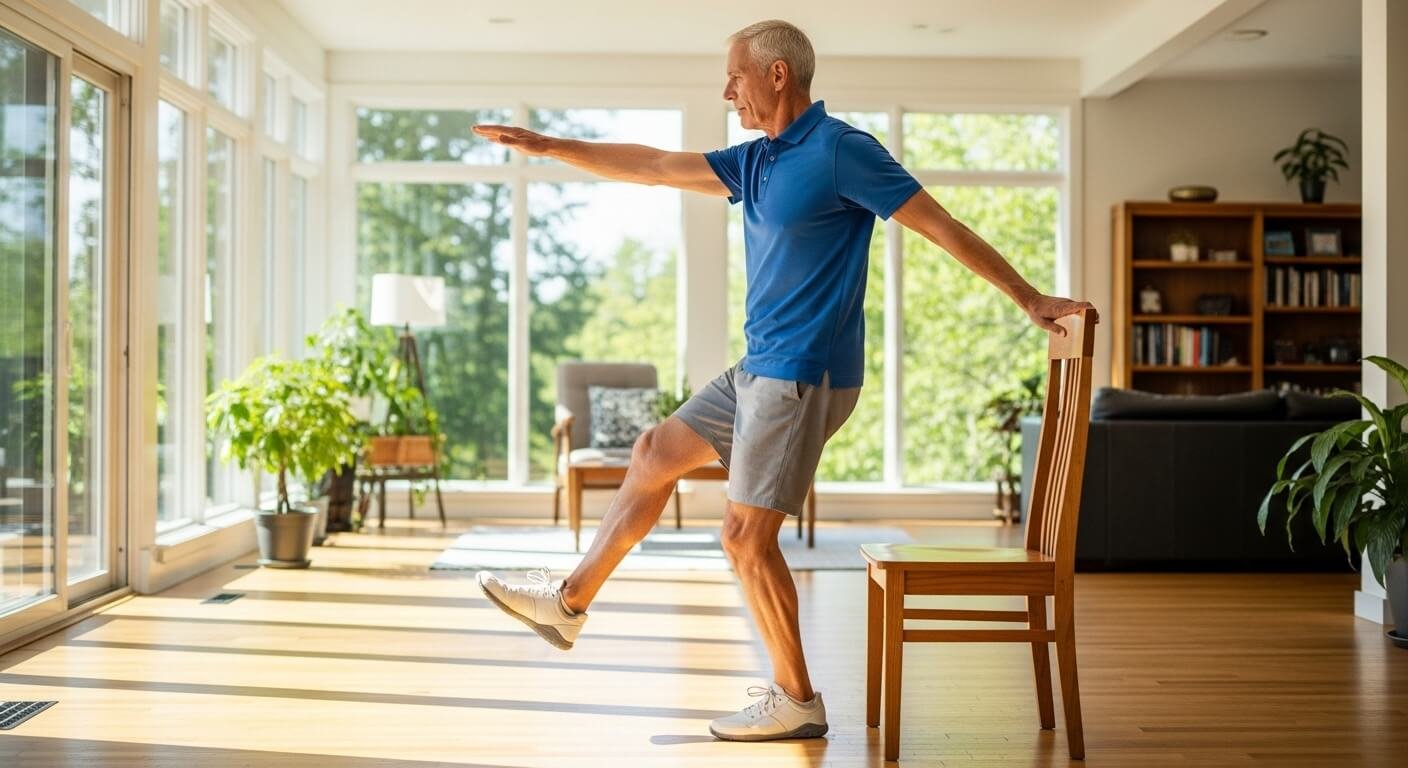
This functional exercise develops the balance and hip stability required for proper weight transfer in your golf swing.
Benefits: Improves single-leg stability, strengthens hip stabilizers, enhances proprioception, develops balance for weight transfer
Equipment needed: Chair or counter for safety support
Instructions:
- Stand next to a chair with your left hand lightly touching it
- Shift your weight to your left leg
- Lift your right foot 2-3 inches off the ground
- Reach your right arm forward, then to the side, then backward
- Maintain balance on your left leg throughout all three reaches
- Complete 5-8 repetitions
- Switch legs and repeat
- Perform 2-3 sets per leg
Calf Raises
Strong calves provide ankle stability and help generate power from the ground during your swing.
Benefits: Strengthens lower legs, improves ankle stability, enhances balance, prevents fatigue while walking the course
Equipment needed: Counter or sturdy surface for balance
Instructions:
- Stand facing a counter with feet hip-width apart
- Lightly touch the counter for balance (don't lean on it)
- Rise up onto the balls of both feet
- Hold the top position for 2 seconds
- Lower slowly back down with control
- Complete 12-15 repetitions
- Perform 2-3 sets
Upper Body and Shoulder Exercises
Resistance Band Rows
Strong upper back muscles maintain proper posture throughout your swing and prevent the forward shoulder slump common in older golfers.
Benefits: Strengthens rhomboids and mid-trapezius, improves posture, counters rounded shoulders, maintains spine angle during the swing
Equipment needed: Resistance band and anchor point
Instructions:
- Anchor a resistance band at waist height
- Stand facing the anchor point, holding both ends of the band
- Step back until you feel tension in the band
- Stand with feet shoulder-width apart, knees slightly bent
- Start with arms extended forward
- Pull both elbows straight back, squeezing your shoulder blades together
- Keep your elbows close to your body
- Hold for 2 seconds, then return to the starting position
- Complete 12-15 repetitions
- Perform 2-3 sets
Resistance Band External Rotations
Rotator cuff strength prevents shoulder injuries—the second most common golf injury after lower back pain.
Benefits: Strengthens rotator cuff muscles, prevents shoulder impingement, improves shoulder health, reduces injury risk
Equipment needed: Resistance band and anchor point
Instructions:
- Anchor a resistance band at elbow height
- Stand sideways to the anchor with your right side closest
- Hold the band in your right hand
- Bend your right elbow to 90 degrees and keep it tucked against your side
- Rotate your forearm outward against the band's resistance
- Move only at the shoulder—your elbow stays against your ribs
- Return slowly to the starting position
- Complete 12-15 repetitions
- Switch sides and repeat
- Perform 2-3 sets per arm
Wall or Counter Push-Ups
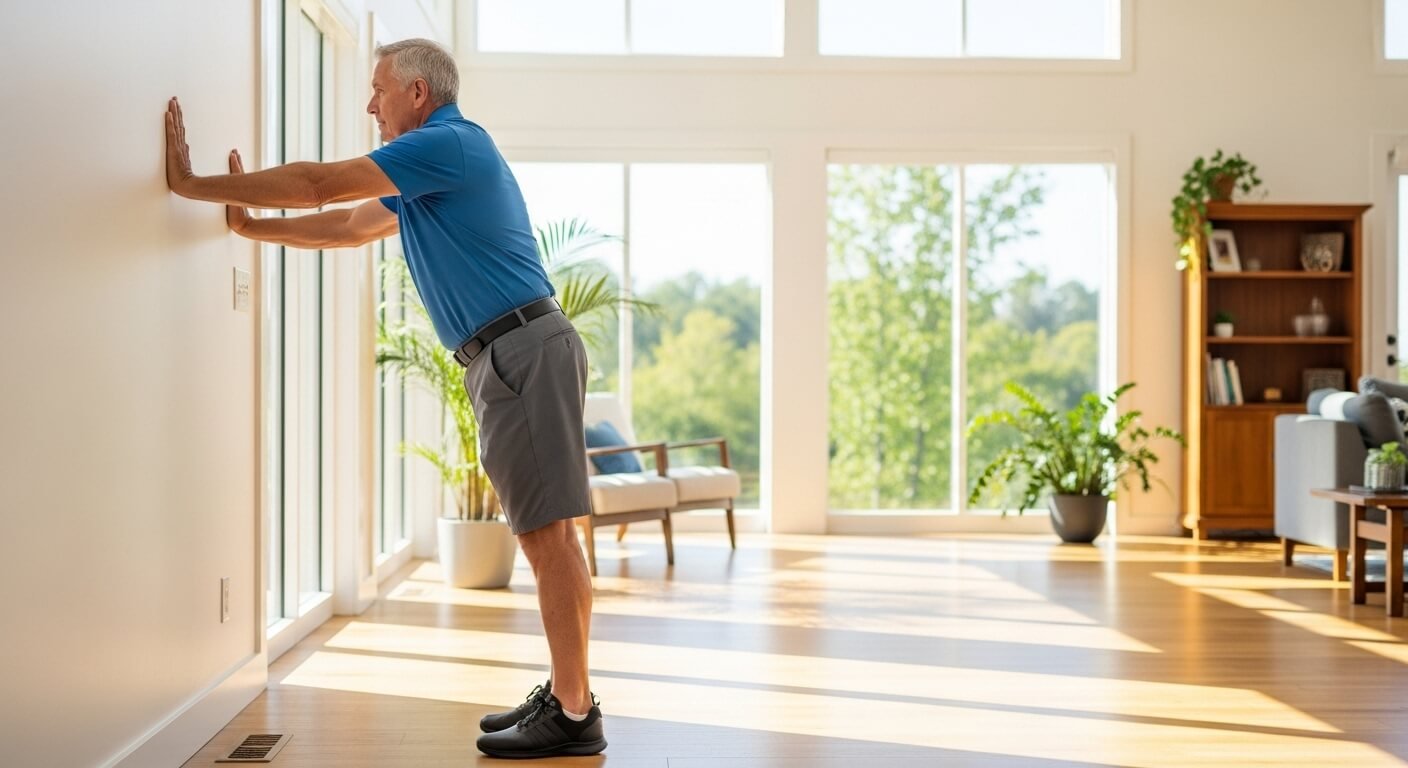
Upper body pushing strength maintains arm structure and club control throughout your swing.
Benefits: Strengthens chest, shoulders, and triceps; improves upper body endurance; maintains arm structure in the swing; builds functional pressing strength
Equipment needed: Wall or kitchen counter
Instructions:
Wall Push-Ups (Beginner)
- Stand facing a wall at arm's length
- Place your hands flat on the wall at shoulder width
- Step your feet back 2-3 feet
- Keep your body in a straight line
- Bend your elbows to lower your chest toward the wall
- Push back to the starting position
- Complete 10-15 repetitions
- Perform 2-3 sets
Counter Push-Ups (Intermediate)
- Place your hands on a counter at shoulder width
- Walk your feet back until your body forms a straight line
- Lower your chest to the counter by bending your elbows
- Push back up to the starting position
- Complete 10-15 repetitions
- Perform 2-3 sets
Best Rotational Power Exercises for Senior Golfers
Rotational power exercises for senior golfers train the explosive twisting motion that generates club head speed and distance.
Standing Exercises with Weight
Standing Torso Rotations with Weight
This exercise develops rotational power through the same movement pattern as your golf swing.
Benefits: Builds rotational power, mimics golf swing pattern, improves sequencing, increases club head speed by 3-7 mph
Equipment needed: Light medicine ball (4-6 lbs) or light dumbbell (5-10 lbs)
Instructions:
- Stand with feet shoulder-width apart
- Hold a medicine ball or weight at chest height with both hands
- Bend your knees slightly into an athletic stance
- Rotate your torso to the right, allowing your hips to follow
- Your weight should shift to your right foot
- Pause briefly, then rotate to the left side
- Your weight shifts to your left foot
- Keep the movement controlled—don't use momentum
- Complete 10-12 rotations per side
- Perform 2-3 sets
Wood Chops (High to Low)
This diagonal movement pattern strengthens the downswing motion and develops power transfer from upper to lower body.
Benefits: Strengthens downswing pattern, develops diagonal power transfer, engages core and hips together, improves swing sequence
Equipment needed: Resistance band with high anchor point or cable machine
Instructions:
- Anchor a resistance band above head height
- Stand sideways to the anchor with your left side closest
- Hold the band with both hands above your left shoulder
- Assume a golf stance with knees slightly bent
- Rotate and pull the band diagonally across your body toward your right hip
- Allow your torso and hips to rotate—mimic your downswing
- Your weight should shift from left to right
- Return slowly to the starting position
- Complete 10-12 repetitions
- Switch sides and repeat
- Perform 2-3 sets per side
Reverse Wood Chops (Low to High)
This exercise strengthens the follow-through motion and builds rotational power from the ground up.
Benefits: Strengthens follow-through, builds upward power generation, improves hip and shoulder coordination, develops finish position strength
Equipment needed: Resistance band with low anchor point or cable machine
Instructions:
- Anchor a resistance band at knee height or lower
- Stand sideways to the anchor with your right side closest
- Hold the band with both hands near your right hip
- Bend your knees slightly
- Rotate and pull the band diagonally upward across your body
- Finish with the band above your left shoulder
- Your torso and hips rotate together
- Your weight shifts from right to left
- Return slowly to the starting position
- Complete 10-12 repetitions
- Switch sides and repeat
- Perform 2-3 sets per side
Resistance Band Rotational Exercises
Banded Rotation from Golf Posture
This exercise trains rotational power while maintaining the spine angle required in your actual golf swing.
Benefits: Trains rotation while maintaining posture, strengthens swing-specific pattern, builds muscle memory, improves spine angle consistency
Equipment needed: Resistance band and anchor point at chest height
Instructions:
- Anchor a resistance band at chest height
- Stand facing away from the anchor in your golf stance
- Hold the band with both hands at chest level
- Maintain your spine angle (slight forward bend from hips)
- Rotate your torso away from the anchor point
- Keep your spine angle constant—don't stand up
- Your hips and shoulders should rotate together
- Hold for 2 seconds at the end of your rotation
- Return slowly to the starting position
- Complete 10-12 repetitions
- Switch sides and repeat
- Perform 2-3 sets per side
Split-Stance Cable/Band Rotations
This exercise develops rotational power from a stable base, teaching proper weight distribution during the swing.
Benefits: Develops ground force generation, trains weight transfer, builds explosive rotation, improves power sequencing from lower to upper body
Equipment needed: Resistance band and anchor point at waist height
Instructions:
- Anchor a resistance band at waist height
- Stand sideways to the anchor in a split stance (inside foot forward)
- Hold the band with both hands near your back hip
- 60% of your weight should be on your back foot
- Rotate explosively toward your front foot
- Your arms extend as you rotate
- Your weight shifts forward to 60% on your front foot
- Return slowly to the starting position
- Complete 10-12 repetitions
- Switch sides and repeat
- Perform 2-3 sets per side
Balance and Stability Exercises for Senior Golfers
Balance training for senior golfers improves weight transfer, reduces fall risk, and creates a stable foundation for consistent ball striking.
Single-Leg Balance Progressions
Progressive balance challenges train the proprioceptive system that controls stability during your swing.
Benefits: Improves proprioception, strengthens ankle and hip stabilizers, enhances weight transfer control, reduces fall risk by 30-40%
Equipment needed: Chair or counter for safety
Instructions:
Level 1: Eyes Open Balance
- Stand next to a chair for safety
- Shift your weight to your left leg
- Lift your right foot 2-3 inches off the ground
- Hold for 30 seconds
- Switch legs and repeat
- Complete 3 repetitions per leg
Level 2: Eyes Closed Balance
- Once Level 1 becomes easy, close your eyes
- Stand on one leg with eyes closed
- Hold for 20-30 seconds
- Switch legs and repeat
- Complete 3 repetitions per leg
Level 3: Balance with Head Turns
- Stand on one leg with eyes open
- Turn your head slowly left and right
- Complete 10 head turns while maintaining balance
- Switch legs and repeat
- Perform 2-3 sets per leg
Heel-to-Toe Walking
This dynamic balance exercise improves walking stability and trains the weight transfer pattern used in your golf swing.
Benefits: Develops dynamic balance, improves walking stability on uneven terrain, trains controlled weight transfer, enhances coordination
Equipment needed: Wall or counter for initial support, clear walking path
Instructions:
- Stand with your right heel directly in front of your left toes
- Touch the wall for balance initially
- Step forward, placing your left heel directly in front of your right toes
- Continue walking heel-to-toe for 10-15 steps
- Use the wall less as you improve
- Turn around and repeat
- Complete 3-4 lengths
Tandem Stance with Club
This golf-specific balance drill trains stability while introducing small rotational movements.
Benefits: Builds balance confidence, trains stability during rotation, improves weight shift control, prepares body for swing motion
Equipment needed: Golf club
Instructions:
- Stand with your right foot directly in front of your left foot (heel to toe)
- Hold a golf club across your chest with both hands
- Hold this position for 30 seconds
- Once stable, add small torso rotations left and right
- Complete 10 rotations while maintaining balance
- Switch foot positions (left foot forward)
- Repeat the sequence
- Perform 2-3 sets with each foot forward
Bosu Ball or Stability Exercises
Unstable surface training challenges your balance system more intensely than solid ground.
Benefits: Advanced proprioceptive training, strengthens small stabilizer muscles, improves reactive balance, enhances body awareness
Equipment needed: Bosu ball or thick foam pad (optional—only if you have experience with balance training)
Safety note: Only attempt unstable surface training if you can easily perform all previous balance exercises. Always have a stable support nearby.
Instructions:
- Place a Bosu ball (dome side up) or foam pad on the ground
- Stand next to a wall or counter for safety
- Step onto the unstable surface with both feet
- Find your balance with minimal wall contact
- Hold for 30-60 seconds
- Progress to weight shifts from foot to foot
- Complete 3-4 repetitions
Sample Golf Exercise Routines for Senior Golfers
Structured workout programs ensure you address all fitness components while maintaining consistency and preventing overtraining.
15-Minute Daily Routine
This efficient routine targets all major fitness components golfers need without requiring significant time commitment.
Equipment needed: Resistance band, chair
| Exercise | Duration/Reps | Focus Area |
|---|---|---|
| Arm Circles & Shoulder Rolls | 20 total circles | Mobility warm-up |
| Seated Spinal Rotation | 3 per side × 20 sec hold | Flexibility |
| Chair Squats | 12-15 reps | Lower body strength |
| Dead Bug | 8-10 per side | Core strength |
| Standing Torso Rotations | 10-12 per side | Rotational power |
| Single-Leg Balance | 30 sec per leg | Balance |
Timing breakdown:
- Warm-up movements: 3 minutes
- Flexibility work: 3 minutes
- Strength exercises: 6 minutes
- Balance training: 3 minutes
Perform this routine 5-6 days per week, ideally in the morning or before practice sessions.
30-Minute Comprehensive Routine (3x Per Week)
This full-body program addresses all fitness domains with adequate volume for continued improvement.
Equipment needed: Resistance band, yoga mat, chair, light medicine ball or dumbbells
Warm-Up (5 minutes)
- Arm circles: 20 reps
- Torso rotations: 20 reps
- Hip circles: 10 per leg, each direction
- Leg swings: 10 per leg, each direction
Flexibility Section (7 minutes)
- Doorway chest stretch: 2 × 30 sec per side
- Seated spinal rotation: 3 × 20 sec per side
- 90/90 hip stretch: 2 × 30 sec per side
- Seated hamstring stretch: 2 × 30 sec per leg
Strength Section (12 minutes)
- Chair squats: 3 sets × 12-15 reps
- Dead bug: 3 sets × 8-10 per side
- Resistance band rows: 3 sets × 12-15 reps
- Bird dog: 3 sets × 8-10 per side
- Calf raises: 3 sets × 12-15 reps
- Wall/counter push-ups: 3 sets × 10-15 reps
Power & Balance Section (4 minutes)
- Standing torso rotations with weight: 2 sets × 10-12 per side
- Single-leg balance progression: 2 × 30 sec per leg
- Heel-to-toe walking: 2 lengths
Cool-Down (2 minutes)
- Cat-cow stretch: 10 reps
- Figure-4 stretch: 30 sec per side
Rest 60-90 seconds between sets. Complete this routine on non-consecutive days (Monday/Wednesday/Friday or Tuesday/Thursday/Saturday).
Pre-Round Warm-Up Routine
Prepare your body for 18 holes with this 10-minute sequence performed at the course before teeing off.
Equipment needed: Golf club
Dynamic Movement Phase (6 minutes)
- Arm circles & shoulder rolls: 20 total reps
- Torso rotations with club: 20 reps, gradually increasing speed
- Hip circles: 10 per leg, each direction
- Lateral lunges: 8 per side
- Calf raises: 15 reps
- Single-leg balance: 20 seconds per leg
Golf-Specific Phase (4 minutes)
- Practice swings at 50% speed: 5 swings
- Practice swings at 75% speed: 5 swings
- Practice swings at 90% speed: 5 swings
- Full speed swings: 3 swings
- Start with wedge, progress to driver on driving range
This routine increases core temperature, activates neuromuscular pathways, and rehearses your swing pattern before beginning play.
Post-Round Recovery Routine
This 8-10 minute sequence reduces muscle soreness and maintains flexibility after walking 18 holes.
Equipment needed: Chair or golf cart
Performed immediately after finishing your round:
- Walk slowly for 3-5 minutes: Gradually lower heart rate
- Seated spinal rotation: 2 × 20 sec per side
- Standing hip flexor stretch: 2 × 30 sec per leg
- Doorway chest stretch: 1 × 30 sec per side
- Seated hamstring stretch: 2 × 30 sec per leg
- Calf stretches: 1 × 30 sec per leg
- Figure-4 stretch: 2 × 30 sec per side
- Cat-cow stretch (if space allows): 8-10 reps
Focus on deep breathing and holding stretches gently without forcing range of motion. This recovery work reduces next-day stiffness by 40-50% and maintains the flexibility gains from your regular training.
Safety Considerations for Senior Golfers Exercising
Understanding safety protocols prevents injuries and ensures your exercise program supports rather than hinders your golf game.
When to Consult Your Doctor
Obtain medical clearance before starting any new exercise program if you have:
- Cardiovascular conditions: Heart disease, high blood pressure, previous heart attack or stroke
- Joint replacements: Hip, knee, or shoulder replacement within the past 12 months
- Chronic conditions: Diabetes, osteoporosis, arthritis, COPD, or other respiratory issues
- Balance disorders: Vertigo, inner ear problems, or frequent falls
- Recent surgeries: Any surgery within the past 6 months
- Unexplained symptoms: Chest pain, dizziness, severe shortness of breath during light activity
Warning signs to stop exercising immediately:
- Sharp or sudden pain (different from normal muscle fatigue)
- Chest tightness or pressure
- Severe shortness of breath
- Dizziness or lightheadedness
- Irregular heartbeat or palpitations
- Nausea or cold sweats
Seek immediate medical attention if these symptoms occur during or after exercise.
Proper Form and Injury Prevention
Form quality matters more than exercise quantity, particularly for older adults with decades of accumulated joint stress.
Key form principles:
- Start with lighter resistance: Use bodyweight or light bands for 2-3 weeks before progressing
- Move through pain-free ranges only: Discomfort from muscle work differs from joint or sharp pain
- Maintain neutral spine: Avoid excessive arching or rounding of your lower back
- Breathe consistently: Never hold your breath during exertion (increases blood pressure)
- Progress gradually: Increase difficulty by 5-10% per week maximum
Understanding discomfort vs. pain:
| Acceptable Discomfort | Stop Immediately |
|---|---|
| Muscle burning or fatigue | Sharp, stabbing sensations |
| Mild stretching sensation | Pain that increases with movement |
| Soreness 24-48 hours later | Joint pain during exercise |
| Feeling challenged but capable | Pain that persists after stopping |
| Symmetric sensations both sides | One-sided acute pain |
Your body provides valuable feedback. Developing body awareness takes time, but listening to these signals prevents injuries that could sideline you for weeks or months.
Modifications for Common Conditions
Adapt exercises to accommodate age-related conditions while still achieving fitness benefits.
Arthritis Adaptations
Joint inflammation requires reduced impact and controlled ranges of motion.
- Reduce repetitions by 30-40% during flare-ups
- Use resistance bands instead of weights (easier on joints)
- Exercise in the morning when stiffness is typically less severe
- Apply heat for 10 minutes before exercise to reduce stiffness
- Avoid exercises that cause joint pain during or after movement
- Consider aquatic exercise on high-pain days
Lower Back Pain Considerations
Chronic back pain affects 60-80% of senior golfers and requires careful exercise selection.
- Avoid exercises involving spinal flexion (forward bending) if you have disc issues
- Emphasize core stability over core flexibility initially
- Use chair support for all standing exercises
- Reduce rotation speed by 50% during power exercises
- Skip exercises that cause pain radiating down the leg
- Focus on hip mobility to reduce lower back compensation
Knee or Hip Replacement Modifications
Joint replacements require 6-12 months for complete healing and tissue adaptation.
- Obtain surgeon clearance before starting exercise (typically 3-6 months post-surgery)
- Avoid deep squatting below 90 degrees for knee replacements
- Limit rotation exercises on the replaced leg for first 6 months
- Use chair support for all balance exercises initially
- Skip impact activities permanently after replacement
- Progress slowly—replacement joints require more recovery time
Balance or Stability Concerns
Fall prevention becomes paramount when balance issues exist.
- Always exercise near a stable surface (wall, counter, or chair)
- Consider exercising with a partner for added safety
- Avoid unstable surface training (Bosu balls, foam pads)
- Perform all single-leg exercises next to support
- Reduce movement speed by 50% for all exercises
- Never close your eyes during balance training
Equipment Safety Tips
Proper equipment use prevents accidents and ensures effective resistance training.
Resistance Band Usage
- Inspect bands before each use for tears, cracks, or wear
- Anchor bands securely—test the anchor before starting
- Keep bands away from sharp objects or rough surfaces
- Never release bands under tension (snap-back injuries)
- Replace bands every 6-12 months with regular use
- Store bands away from direct sunlight and heat
Stable Furniture for Support
- Test all chairs, counters, and surfaces before using as support
- Avoid wheeled furniture (office chairs, rolling carts)
- Place exercise mats on non-slip surfaces
- Clear 6-8 feet of space around exercise area
- Remove tripping hazards (rugs, cords, clutter)
- Exercise in well-lit areas to see potential hazards
Non-Slip Surfaces
- Wear athletic shoes with rubber soles (never socks alone)
- Use yoga mats on tile or hardwood floors
- Avoid exercising on carpet that catches your feet
- Wipe up any moisture immediately
- Consider non-slip grip socks if you prefer not wearing shoes